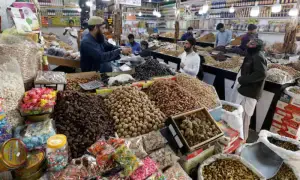
It is a chilly evening in Islamabad and it may rain any minute. I am trying to huddle as close to the cheerful fireplace as possible in the comfort of Ayesha Siddiqa's living room, munching on dry fruit and managing the shells while conducting a conversation
Her conversation is animated but she is no fire-breathing dragon as the official opponents of her groundbreaking book Military Inc. believe. In the book she has provided a brilliant and meticulously detailed expose of the military's foray in the world of business enterprise.
No stranger to controversy, she is aware that the next book she is working on may prove to be no less hard-hitting. She has a working title for the book but has asked me not to divulge it. I can keep a secret as far as titles are concerned, but not the subject matter. In her work-in-progress she has taken on the major change that is taking place in southern Punjab.
She spells out her theme as 'the different worlds which co-exist in the south of Punjab, the world of puritanism, prostitution, pirs and feudal lords, drug peddlers and gamblers.'
She has carried out numerous interviews with women and families who have lost their young ones to the militant cause. This alone would have made for riveting reading, but this time she is approaching the material with a different style.
In order to do justice to her theme she is 'mixing fact and fiction so it will be facts masquerading as fiction. Is tarah fiction likhnay ki tharak poori hogi', she explains with a smile.
Ayesha Siddiqa fondly recalls that she used to write stories as a child. She was exposed to literature early on and read the Russian classics. Reading remained important but writing was something she did not take to easily.
'My mother wanted me to become a fiction writer but I kept fighting this,' she recalls. 'It took me many years to get back to her legacy,' she says paying tribute to her mother, the distinguished Urdu novelist Jamila Hashmi, whose dreams she fulfilled but in her own way.
She has organised memorial lectures to honour her mother and recently one such event was held in Islamabad, at which she announced the establishment of a literary prize named after her parents.
'I confess that I could not manage to adapt to the higher form of writing which is fiction. Storytellers, be it poets or prose writers, can do more in inspiring ideas and keeping nations alive. They can describe any society much more creatively and tell you more about current events than in other kinds of writing.'
'Fiction is deep-rooted within me,' she says as she describes the direction her work has developed in. 'The impulse for writing took me towards another form. I still believe that fiction is a higher form of writing. My next book may be my transition to fiction!'
As far as working habits are concerned, she says that she works with discipline when she has to do academic writing. She feels that there have been many choices before her; she left her career in the civil service and politics is till an option for her, but writing remains a passion 'writing helps me connect with my inner soul — I love writing'.
'Writing, be it fiction or non-fiction, requires inspiration and not just of ideas but also of conviction and courage to speak the truth and stand up for it.
'Some might call this inspiration and madness but then my mother used to tell me that this world moves on not just because of the most clever and pragmatic, but because of those who are mad enough to dream and say things.'
Convictions notwithstanding, her experience with publishing is varied. 'It was good, because people read the book, but not good at all in monetary sense. Promises from publishers do not always materialise!'
For the government, the economy may be more stable now than it was three years ago, but for manufacturers and exporters, it is still difficult to do business.



 0
0