0
0

Few would refute the fact that the more taxing the circumstances — and if one could withstand that initial encumbering phase — the more polished and refined one’s skill would be. The veracity of this view besets us all: a diamond awaits shining in its full glory while buried deep in a coal mine for years. Similarly a pearl remains hidden in a seashell on some ocean bed before being discovered and admired.
Granted, this is a rule set by nature. What is not so natural, and quite unsettling, however, is the nonchalance that any precious object, unprecedented phenomenon or a gifted human being faces even after having proved themselves to the world. Case in point: the cue-wielding gentlemen who passionately endeavour to keep snooker alive in Pakistan.
At this point, it goes without saying that it is solely the will of the people involved in this indoor sport, and the vehemence that they carry in their hearts, which keeps them going. Otherwise, not much heed is paid to this classy sport despite the fact that Pakistan spawns so many talented players every year.
Before getting into the numerous reasons owing to which the sport suffers, we need to bear in mind the distinctive traits of the game.
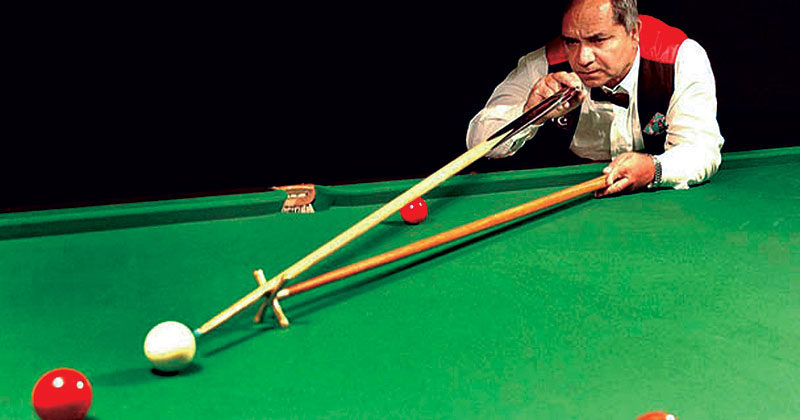
Snooker is not merely about a haphazard collection of a few multi-coloured balls aimlessly scattered across a 12-foot by six-foot table to be potted randomly as per the whims of a person swinging a stick without any purpose. It is an intricate sport which not only demands physical involvement but mental work as well.
The game may appear serene but once a player has played a few intense frames, each of which may last somewhere between 15 to 30 minutes depending on the ability and form of the players, the fatigue that sets in can make even the brawniest of players break into a sweat. Thinking also happens to be an integral part of the game in order to plan one’s own moves, as well as discern the opponent’s intentions.
Financial hurdles
The point being emphasised is the wearying process that one has to go through to shine at the higher levels. Unfortunately, in Pakistan, this already quite difficult path is made jagged due to an absolute lack of support by the authorities. Naveed Kapadia, one of the higher officials working for the Pakistan Billiards and Snooker Association and Sindh’s organiser shares: “We funded the group of players that went to partake in the last World Cup. Those funds are yet to be reimbursed by the government.
“Similarly, last year four players were sent to Thailand for training. We funded that too. Karachi Metropolitan Corporation very generously gave us a plot on Kashmir Road to build an academy there but we await financial support to do that. And all this is on the national level. At the provincial level, things are worse. We don’t even get to know about them at times. However, negativity aside, in spite of all these hurdles, we have won the World Cup in the past, and currently hold the second spot in Asia, a commendable feat given the current scenario.”
Snooker parlours
Taking into account that our players do not have a training facility, yet they keep pulling off miracles at the national and continental levels, the credit primarily goes — of course, after the fervent youth which adapts to practically any situation — to all these small and medium-sized snooker parlours and clubs running in the lanes and streets of different cities in Pakistan.
The facilities that such places provide are certainly way inferior to the state-of-the-art gear present in clubs in the United Kingdom, Thailand and China. The cues that the players use are usually bent as they are quite often made of cheap wood not appropriate for such delicate playing equipment.
Moreover, the tables that they start their careers on are far from what we get to see at the international or even continental level as they are almost always lopsided, tilting towards one side or the other, making the players’ technique and accuracy suffer. The green or blue baize on the tables is mostly scuffed at different points which sometimes makes the balls bounce and go into inadvertent directions. Still the players are charged for every minute they spend playing in such places making it a substantially pricey affair; especially, for the losing player who has to bear the cost of the entire frame.
Another significant impediment that our players face is an absolute dearth of peace in such clubs. Snooker is known to be a game played in pin drop silence as it requires immense concentration. However, in our clubs, youngsters have to learn to overcome this mental obstruction amidst loud music, a rowdy and boisterous crowd, and at times, blinding cigarette smoke.
Time-consuming hard work
Mohammad Sajjad, a former Pakistan number one player from Sargodha, sheds light upon this issue: “It requires at least seven to eight hours of daily practice for a professional. Without an academy, it gets extremely expensive for the players to practice in street clubs; not to mention that one cannot keep a regular nine-to-five job if one is to practice this much.
“I think what the game needs is more sponsors. Different organisations and companies should step up for this. In the same way, the players should be offered jobs, which will not only support them financially, but also their game. This is very important as we have to endure a great deal before we manage to make a name for ourselves.
“I appeared in the Punjab Cup for five consecutive years and competed against four to five hundred other cueists every year before finally winning it and getting noticed. Till then, I was totally on my own.”
Lack of incentives
As is the case with any other aspect of life, there are stories that can be termed as exceptions where the players simply depended on their luck to get to the top. Hamza Akbar, currently the number one cueist in Pakistan, reflects:
“I hail from Faisalabad where I started at a small club. Unlike a few other top players that I know, I got very lucky in my formative years. My club used to finance my practice and even send me to different parts of the country for training as well as taking part in different tournaments. But like I said, I was only lucky. Not everyone gets such chances.”
Commenting further on the monetary side of the game, Hamza suggests: “It is my observation that snooker is the most played game in Pakistan. Practically every street in even the remotest of areas has a club. Despite that, the game does not get that much attention and funding from the government. The cheque for the winner of the annual National Championship is Rs 80,000. The amount has gone up a little as compared to what the players used to get previously. However, there is still a huge void between snooker and some of the other sports played across the country as far as the monetary benefits are concerned.”
Offsetting the downsides of the whole picture, what brings positivity and, most importantly, hope to the entire state of affairs is the proven fact that over the last few decades, as challenging as the conditions may have been, Pakistan has managed to produce not just simply good or competent players, but fighters in its truest essence who have later scaled the ladder of glory only on the basis of their own willpower.
Success story
The iconic Mohammad Yousuf, a man who does not need any kind of introduction, and inspires millions, has a grand tale of struggle, courage and triumph to share: “I started playing in Mumbai as a kid back in 1963-64. Later, I moved to Karachi and found a few snooker clubs at Empress Market. I started selling newspapers and fruit to fund my practice at the club in the evenings. My big break came in 1985 when I lost the final of the biggest local tournament of that time against the legendary Latif Amir Bakhsh.
“That was when Mr Valika offered me a job at Karachi Club in 1986. The same year, I got an opportunity to represent Pakistan in Sri Lanka and became Asian number three. I never looked back after that. I became the national champion in 1987 and held that spot till 1993.
Somewhere in the middle I won two international tournaments, too. Yet, two of my biggest achievements were yet to come. I became the first Pakistani ever to lift the Amateur World Cup trophy in 1994, which was ensued by an Asian Championship in 1998 where I defeated my opponent from Thailand in the final. “You might find it a bit difficult to believe, but I took a hiatus from snooker for more than 10 years between 1970 and 1985 when I went to Lahore and became the All Punjab Carom Champion.”
Just a slight bit of support from the concerned authorities and the raw talent of our cueists that still manages to prove its mettle despite all the hindrances, can outshine every other nation at the international level.