As a rule I do not review the works of a calligrapher. First, because I do not consider the genre as what is universally recognised as art, irrespective of how much embellishment is wrapped around the words. Second, I am no authority on the subject — far from it. And third, in Pakistan I would be simply terrified at the possibility of the craftsman having made a mistake, however minor, in the application of a passage from the Holy Book.
It is so terribly easy to get the punctuation wrong if the quill or brush slips, however inadvertently, at the crucial moment. Of course, I made an exception in the case of Mohammed Ali Talpur; because this man, like Moin Faruqi, master of the extreme facial expression who had seen the other side of the rainbow, found the road to Valhalla. Besides, Talpur really has no equal in his field.
But heck, I succumbed for the second time in two weeks. I was seduced by the invitation card. The images in blue and gold and red and gold in different shapes and sizes were crisp and compelling. I had never heard of Ruheena Malik, and she hadn’t heard of me … touché. She spends a considerable amount of time in northern Europe — and I don’t. But the illustrations were so enticing I simply had to see the work. And so, on Sunday, I phoned her and got her to open the gallery in Flagstaff House where her treasures of Islamic calligraphy were stored. I took my sister-in-law with me as she was supremely familiar with the Holy
Quran
My first reaction was one of awe and wonder. It was as if I had entered another dimension where the walls of the world had been torn asunder to reveal the Truth, as inscribed in passages from the Holy Book. Malik had culled nuggets from across the huge oeuvre. Besides the 18 plaques there was a Burraq, some Nads and Quls, exquisitely reproduced on wood.
A composition where the lapis lazuli has been crushed and mixed with gum Arabic pleaded for attention. And … there is the inevitable camel, the ship of the desert, and horses in various hues studded with superbly structured script on the mane. The horse has always been the toe-clenching symbol of power, strength, speed and achievement and figures prominently in world folklore. Hang on, there is also a door and a clutch of misshapen wooden chests, curved on the sides so they could be strapped onto a camel. She informed me that she has collected these pieces from Mithi, Thar and Hyderabad.
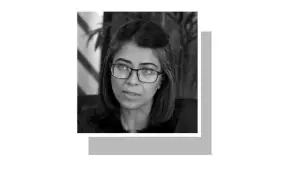
Ruheena Malik is completely self-taught, though she did attend some calligraphic classes in China. She hasn’t been inspired by anybody in particular. She delves only in calligraphy and doesn’t do anything else, except collect old pieces of furniture from the rural landscape. The amount of time spent on a composition could stretch from a day to a year.
She comes across as a person who is eager to learn. “I see no boundaries,” she says. “I have my own style. Mind you, you can do anything you want with Arabic symbols.” She is jolly right. Malik has exhibited in Lahore and Islamabad in 2009, and is busy planning her next exhibition. I promised I wouldn’t tell anyone what it is.