0
0


VIENNA: Thousands of children were murdered by the Nazis because they fell short of the Aryan ideal. On Friday, a hushed audience gathered in Austria's Parliament to watch the world premiere of an opera depicting how the Nazis methodically killed mentally or physically deficient children at a Vienna hospital during World War II.
The killings were part of a greater campaign that led to the deaths of about 75,000 people — homosexuals, the handicapped, or others the Nazis called "unworthy lives" — and served as a prelude to the Holocaust.
Austrians played a huge role in these and other atrocities of the era — nearly 800 children were killed at Vienna's Spiegelgrund psychiatric ward — and Friday's premiere of the opera "Spiegelgrund" was the latest installment of a national effort to atone for such acts in word and deed.
The timing was picked to commemorate Holocaust Memorial Day, which will be observed worldwide Sunday, and the performance was streamed live on the Internet for international audiences. But the parliamentary venue was chosen for a particularly Austrian reason: as a reminder of how the country's politicians fomented the atmosphere of intolerance and authoritarianism that allowed Hitler's troops to walk in in 1938, and a determination to not let history repeat itself.
Composer Peter Androsch said his focus on the era was in part born of his own family's history. His great grandfather died in a Nazi concentration camp. Androsch said the fact that that was hidden for generations "says a lot about conditions in totalitarian regimes and should serve as a reminder for me and many others."
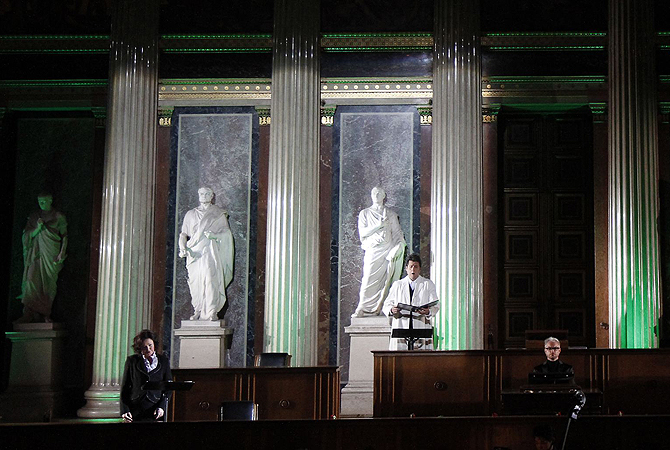
At the premiere — a hauntingly effective hour-long performance — legislators were joined in the audience by diplomats, Holocaust survivors, former Spiegelgrund patients and other invited guests in an ornate chamber lined with Ionic columns and used for special legislative sessions.
Spiegelgrund survivor Friedrich Zavel was in the audience. He was brought to the clinic in 1940 after being accused of homosexuality. Now 83, he still shudders when he speaks of his ordeals: humiliation, solitary confinement and torture.
The "Wrap Treatment" consisted of orderlies binding a child first in two sheets soaked in ice water, then two dry sheets, followed by waiting for days without food and drink until the body warmth dried the sheets. There also were beatings and injections that either made the child vomit or left him unable to walk for days.Asked Friday how he felt about the wrongs done to him, Zavel said: "I know neither revenge nor hate."
The opera itself was more of an oratory. Backlit in gloomy purple and red, and accompanied by strings, flute, percussion and a harpsichord, a trio slipped into each other's roles in an allegorical depiction of how all are victims and perpetrators.
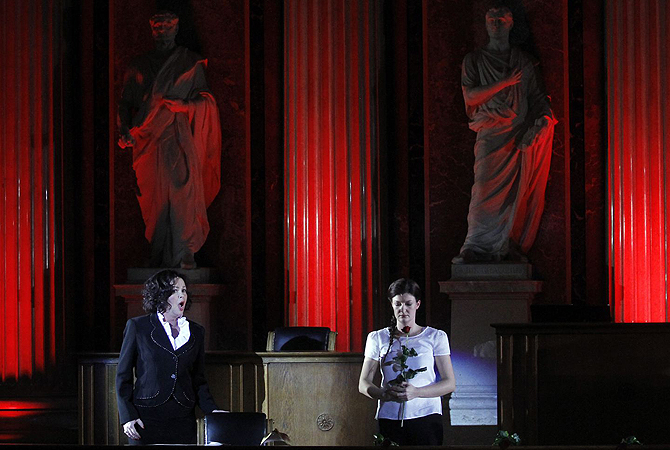
Thus a white-coated doctor embodying "The Law" switched from vocalizing about Sparta's doctrine of letting weak newborns die to singing a child's ditty before moving to the role of "Memory" — singing broken phrases that harken back to the horrific experiences of the victimized children. The two other singers shifted roles accordingly as a narrator dryly recited facts reflecting the atrocities committed.
"On some days, so many children were killed that the orderlies had to pile the little bodies on a wheelbarrow," narrator Karl Sibelius intones in one sequence before reading a letter from a mother addressed to an institute doctor and pleading for the return of her son.
Bass Robert Holzer was "The Law," and sopranos Katerina Beranova and Alexandra Diesterhoeft sang "Memory" and "Children's Song" respectively. All were very solid.
Parliament President Barbara Prammer said the nation could no longer focus only on glorifying its past.
"We can't choose our history," she told The Associated Press.