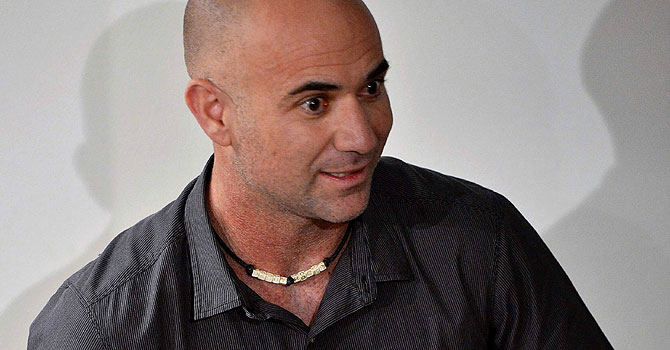
MELBOURNE: American great Andre Agassi Friday urged tennis to do whatever it takes to curb doping, saying stronger controls would have stopped him “destroying” years of his life with recreational drugs.
Agassi, describing his shock and anger at Lance Armstrong's confession he cheated his way to seven Tour de France wins, spoke candidly about his use of crystal methamphetamine, which he first revealed in his autobiography.
“For me, it would have kept me from destroying a few years of my life. That's what I did to myself with the use of the recreational, destructive substance of crystal meth,” he said at the Australian Open in Melbourne.
“It would have saved me on a lot of fronts. The more (controls) the better as far as I'm concerned. The stricter, the better; the more transparency the better; the more accountability the better.
“Describing a problem is a heck of a lot easier than solving it, is one thing I've learned. Let's always have the discussion of making it more comprehensive.”
Drug cases are rare in tennis but its anti-doping system, which relies largely on urine rather than blood tests, has been criticised as outdated, and some suspicions have been voiced about leading players.
Agassi said in his 2009 book, “Open”, that he went unpunished by the men's tennis tour after failing a drugs test, when he claimed he consumed a spiked drink and pleaded leniency.
But he said he wouldn't have known how to get away with the sort of cheating admitted by Armstrong, who took a cocktail of performance-enhancing substances over many years.
“As far as tennis goes, I can speak comprehensively to the rules and regulations, but not to how they've changed since I left the game,” said the eight-time Grand Slam champion, 42.
“It's a sport where I wouldn't know how to get away with that level of cheating. It's a year-round sport.
“It's an out-of-body governance, a third-party governance. When last I played, it was comprehensive in the sense of nearly every tournament, nearly week to week, blood, urine, out of competition testing.
“I don't know how it's changed, but if it's stayed the same at least that's a good thing.
“Anything that can protect the integrity of the sport, and those that aren't cheating, should absolutely be considered.”
Agassi added that he was angered and disappointed by the final confirmation that Armstrong was a drug cheat.
“My reaction to it is the same as everybody. It was shock, hard to stomach, sadness, disappointment. I think 'anger' is a fair word,” he said.
“I was certainly one of those that flat-out believed him that long period of time. The thought of it not being the case was unconscionable to me.”