0
0

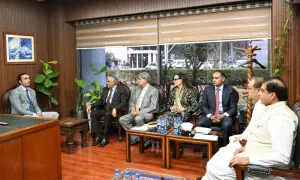
ISLAMABAD, Dec 29: Seven Pakistani policewomen visiting the United States on invitation of the State Department have urged the parliament to set aside ten per cent of slots in the Police Academy for women and members of minority communities.
Taking part in a debate during their visit to the US Institute of Peace, the seven officers said that policewomen in Pakistan were discriminated against and generally lacked access to training and technology, said a press release on Saturday.
They said the policewomen could excel in their profession if they were given the right opportunities. The handout did not name the officers.
The seven officers said they felt comfortable while working in an all-woman police station, where they carried out the same work as their male colleagues.
They, however, acknowledged that creating separate police stations for the two sexes could result in lopsided services for Pakistani women and men. Currently, the all-woman stations existed in some major cities only.
Even though policemen and policewomen were given the same training at the academy, upon graduation the women officers were often given desk jobs and other administrative duties, they said.
The resultant lack of field training put the women officers at a disadvantage with regard to promotions, they said. Even if the women were promoted to a higher rank they were not given the same responsibilities as their male colleagues in that rank.
They said that all police officers, particularly women, needed additional training in weapons, forensics and technology.
One of them said that it took ten Pakistani officers to accomplish what one American officer could do, the main difference being access to technology and training.
Despite the challenges they faced, the women officers could make unique contributions to policing in Pakistan, the seven officers said. Women officers might act as a natural liaison between the police force and the community as they could interact successfully with certain sections of society that were often beyond the reach of men officers.
This could have positive implications for police effectiveness by strengthening civilian-police relations and fostering cooperation between the two, they said.
In addition, the successful women police officers could act as role models for the next generation and encourage Pakistani women in general to pursue their chosen professions, they said.
Apart from the structural and departmental constraints they faced, the policewomen must work in a society where women often faced cultural and political restrictions.
While Islamabad was rather progressive, in many of the outlying areas aspiring to be a police officer was not socially acceptable for a woman. Young women were often discouraged, and even forbidden, by their male relatives from applying for a police job.
Once a woman was accepted by the Police Academy, she had to overcome social stigma besides balancing a demanding job with her traditional role at home, they added.