0
0

KARACHI, Dec 27: High prices of locally manufactured clothes and inflation have resulted in an increase of import of second-hand clothes that sell briskly across the country.
Figures of Pakistan Bureau of Statistics (PBS) revealed import of 167,969 tons ($63 million) of worn clothing (jackets, sweaters, trousers, shirts, overcoats, kids garments, etc) in July-November 2012 as compared 158,942 tons ($59 million) in the same period of 2011.
In July-June 2011-2012 import of such items rose to 402,864 tons ($147 million) from 353,831 tons ($129 million), showing rising demand of these items.
Light House and its adjacent areas at M. A. Jinnah Road is considered as the hub of used items but in the last few years used wearable articles have been visible in almost all the main markets across the country followed by rising trend of selling these items on push carts.
High imports of used items (both summer and winter wear) suggest that the living standard of many people has actually fallen.
For instance, the price of a good quality locally produced sweater ranges between Rs1,500-4,000. The high prices actually forces many middle and lower class people to buy sub-standard quality at low prices while consumers try to sort out it in Lunda Bazar at Rs100-300. Even many people cannot afford new sweaters at Rs800-1,000.
Traders demand Rs500 for used artificial leather jackets as they know that people cannot buy band new good quality at Rs1,200 to Rs2,500, while one can imagine the price of original leather jackets.
Traders quote Rs250-500 for used shoes which attracts many people as medium and high quality leather shoes carries price of Rs1,500-2,500. Used shoes for kids carry a price of Rs100-200 while new shoes cost Rs750-1,200.
President Karachi Second-hand Clothing Merchants Group (KSCMG) Salim Wakani said local traders lift blankets and quilts in bale or bulk form (without sorting) at Rs40-45 per kg while the rate of jackets is Rs15-20 per kg. The price of sweaters and shoes is Rs20-22 and Rs10-12 per kg respectively. Later, the local traders take the bulk purchase to Haji Camp or at Light House to sort out qualities, he informed.
“The demand of used clothing and other items is going up due to rising poverty and falling purchasing power,” he commented.
It is believed that poverty in Pakistan is over 40 per cent while food insecurity is 57 per cent.
He said for the last two years deteriorating law and order situation in Karachi has restricted the visit of up country buyers in Karachi. Traders of Sindh, Punjab and Balochistan used to make heavy purchases from Karachi by personally visiting the city. “Now instead of coming here they were contacting on cell phones to purchase items from Karachi dealers and importers through local agents,” he said.
“Our sales to up country local traders have declined by at least 10-15 per cent due to slow down in arrivals of buyers from other provinces. Our godowns are full of worn clothing materials,” he said.
On increase in prices, he said that import is getting costlier due to rupee devaluation against the dollar besides and high freight rates while the prices of used items in world markets did not increase from the suppliers. Used items are mainly arrive from European countries, USA, Japan, Malaysia, Korea, etc. after going through the process of sorting, grading, fumigation and packing.
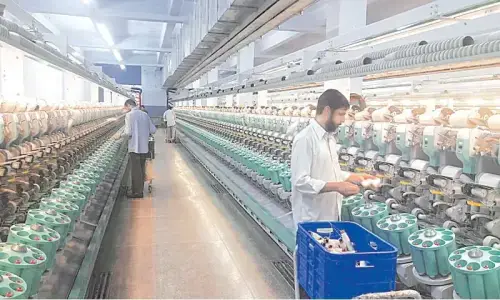
It is also interesting that production of locally made woolen blankets had surged to 28,517 in July-October 2012-2013 from 21,738 followed by rise in woolen and worsted cloth to 769,000 square meters from 692,000 and knitting wool to 844 tons from 730 tons, PBS figures revealed.
Consumer price index (CPI) in 2011-2012 and food inflation were recorded at 11 per cent reach. In July-November 2012 the CPI stood at 8.4 per cent while food inflation was 7.2 per cent. The Pak Rupee lost its value against the dollar by nine per cent in 2011, while from January to December 27, 2012, the rupee saw depreciation of 7.8 per cent, thus pushing up cost of imported items.