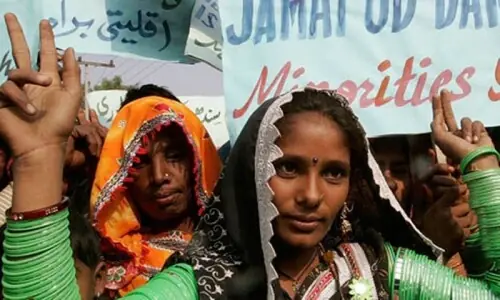
WASHINGTON: An official US report warns that future terrorists could come from many different religions, including Christianity and Hinduism.
“Right-wing and left-wing ideological groups — some of the oldest users of terrorist tactics — also will pose threats,” the report adds.
But it hopes that the withdrawal of US forces from Iraq and a reduced military presence in Afghanistan will also decrease the terrorists’ ability to use America for stirring up Muslim anger.
“The Future of Terrorism” is part of a larger report that studies global trends between now and 2030. The report was partially released earlier this month but the complete version has now been placed on the US State Department’s website.
“The impending withdrawal of US forces from Iraq and decreases in US forces in Afghanistan will help to reduce the extent to which terrorists can draw on the United States as a lightning rod for anger,” says the report prepared by US intelligence agencies for American policymakers.
“Soon, US support for Israel could be the last remaining major focus of Muslim anger,” the report adds.
Several circumstances are ending the current Islamist phase of terrorism, indicating that “the recent religious wave is receding and could end by 2030”, the report adds.
It points out that past terrorist waves, the Anarchists in the 1880s and 90s, the post-war anti-colonial terrorist movements, the new left in 1970s, also ended in a similar fashion.
But the report wants that “terrorism is unlikely to die completely because it has no single cause”. The report compares terrorism to a forest fire and says that traditional use of the term “root cause” for understanding what drives terrorism is misleading. Like a forest fire, “a mixture of conditions such as dry heat, a spark, and wind lead to terrorism” as well.
Defining the United States as a receding enemy, the report notes that although Al Qaeda and others have focused on the United States as a clear enemy, the appeal of the United States as the “great enemy” is declining.
Moral resurgence of secular democracy in the Arab world, the report adds, will also help defuse terrorism as the Arab uprisings were non-violent struggles and “protesters acted in the name of democratic values, not in the name of religion.”
The report also claims that future generations in the Arab and Muslim worlds may not agree with the perceptions of the older generations and may not want to carry on their battles.
“A new generation may simply view things differently and be less interested in an old narrative,” which caused conflicts between Muslims and the West, says the report.
The war in Afghanistan cost Al Qaeda its initial base and forced it to move into the more difficult environment in the tribal areas of Pakistan, the report adds. This enabled the United States to attack and kill many senior Al Qaeda leaders and key operatives.
“In the short term, the Al Qaeda core might still be able to launch attacks” but like previous terrorist organisations such as the Baader-Meinhof group in the 1970s, it will become ineffective, the report says.
“Some Al Qaeda affiliates and other types of Islamist terrorist organisations, however, are likely to pose more serious threats,” the report warns. But “Shia groups such as Hezbollah will continue to see terrorism as a means to achieve their objectives,” the report adds.
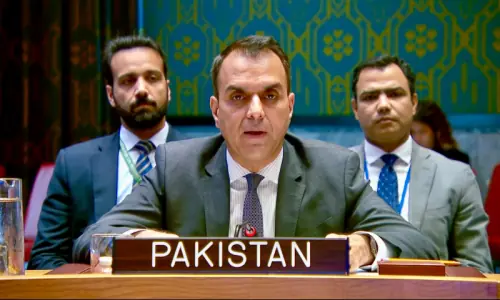
States managing terrorism: The report says that many states might continue to use terrorist groups; exploiting terrorist movements out of a strong sense of insecurity. It claims that states such as Pakistan and Iran feel threatened by what they perceive as stronger, threatening powers in their regions or globally.
Therefore, they seek asymmetric options to assert power and deter attack; using terrorist groups as proxies and pursuing nuclear weapons are two such asymmetric tools.
“However, international disapproval of state support for terrorist movements has increased significantly, and the costs to a regime of directly supporting terrorists looks set to become even greater as international cooperation increases,” the report concludes.