0
0

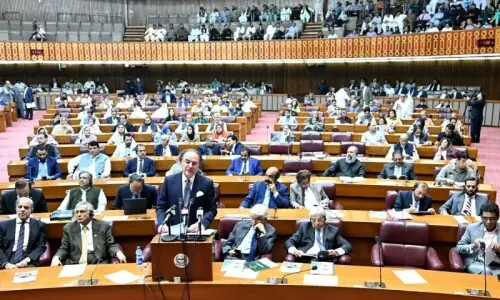
ISLAMABAD, Dec 15: The Senate may debate the report of the United Nations inquiry commission on the assassination of Benazir Bhutto, as a motion moved by the Muttahida Qaumi Movement (MQM) on the issue has been placed on agenda of the Monday session of upper house, Dawn has learnt.
MQM Senator Col (retd) Tahir Mashhadi through the motion filed under Rule 218 of the Rules of Procedure and Conduct of Business in the Senate has sought a discussion on the “UN commission report on assassination of Benazir Bhutto and the progress made so far in this regard”.
The motion has come on the agenda of the session to be held just 10 days before the fifth death anniversary of the PPP leader and former prime minister who was assassinated in a terrorist attack on Dec 27, 2007, in Rawalpindi.
Talking to Dawn, Mr Mashhadi said it was strange that the government had referred the inquiry of Ms Bhutto’s murder to the UN through a resolution passed by the parliament, but it did not present the report to the house for a discussion despite the fact that the commission had completed its task within the stipulated time.
The MQM senator said the government had on several occasions announced that it would catch the killers of Ms Bhutto after completion of the UN report. Moreover, he said, millions of dollars from the national exchequer had been spent for carrying out the UN probe.
He said the commission had come up with certain recommendations and it was the right of Pakistanis to know what steps so far the government had taken for their implementation.
It was in light of the first resolution passed by the National Assembly on April 14, 2008, that the inquiry was handed over to the UN commission which submitted its report to the government on April 15, 2010.
The resolution had “recommended that the government should approach the UN to get Ms Bhutto’s assassination probed by forming an international investigation commission and “to identify the culprits, perpetrators, organisers and financiers behind this heinous crime and bring them to justice”.
Within 48 hours of the release of the UN commission report, the PPP had first decided to take “appropriate legal actions” against all those, including former president Gen (retd) Pervez Musharraf, whose names had been mentioned in the report among people responsible for the murder.
It was after a meeting of the party’s core group at the presidency on April 17, 2010, that PPP co-chairman and President Asif Zardari had asked the-then prime minister, Yousuf Raza Gilani, to take “appropriate legal action” in the light of the UN commission’s report which had “called upon the competent authorities in Pakistan to make a determination of the criminal responsibility for planning and carrying out the assassination”.
After the meeting the presidency’s spokesman, Farhatullah Babar, had said the party had “accepted” the report and that it had further recommended to Mr Gilani “to take appropriate legal action against those government officials mentioned in the UN report”.
The meeting, he said, had reiterated that the report had endorsed the party’s position that former military ruler “Gen (retd) Pervez Musharraf was responsible for the assassination of Benazir Bhutto”.
Later, the PPP leadership all of a sudden rejected the report and dumped it.
When contacted, Mr Babar admitted that the party had initially welcomed the report, but said that after studying it in detail the party found it “inadequate”.
Answering a query, Mr Babar said the party had to reject the report because members of the commission had not contacted some “heads of the government” and “international figures” who, he said, the party believed should have been contacted.
He, however, refused to divulge the names of the international personalities which the PPP wanted to be approached by the commission.
When asked why the report was not presented before the parliament, Mr Babar said this was not required.
On the other hand, he said any member could bring the report under discussion in the parliament. He said it was good that the MQM had moved such a motion as it would provide an opportunity to the PPP to make its position and stance clear on the subject.