0
0

During these entertainment-starved times, there is a village near the Chakwal city which still organises an annual fair, providing the best source of recreation to people from all walks of life.
The fair has been held without a break in the sleepy village of Karsal since 1920 in connection with the Urs of Hazrat Syed Walait Shah, the saint who is described as the “sole heir of Bari Imam” as the latter was born in Karsal about four centuries ago.
The life in Karsal village, located about 26 km to the west of Chakwal city, gets bloomed in September as this is the month of “Mela Karsal”.
As the saint Walait Shah spent some period of his life in Lahore, the dancing girls of Heera Mandi along with thousands of other people became his disciples. Since the death of their Murshed in 1920, the dancing girls and noted singers along with thousands of other devotees have been attending the Mela Karsal.
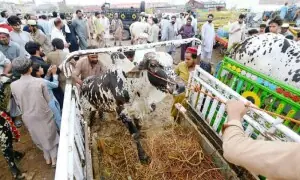
The four-day event begins with special prayers and includes horse dance, shooting ball match, Kabaddi, Karah (bull show) daali (a procession taken out from the one end of the village to the other) and the most desired and watched event of dance. The road leading to Karsal village, which is sparsely travelled on normal days, is flooded with all kinds of traffic as the fair begins. The streets of the village turn into bazaars. During day, events like horse dance, Kabbadi and Karah are held but when night descends the village is echoed with the clangs of “Ghungru” (small bells) and beats of Dhol (drum).
More than 100 dancing girls from various cities of Punjab mesmerises the audience with their performance. The people of Karsal village, who have grand houses, vacate their homes to accommodate the dancing girls.
The dancing girls perform groups and each group is given equal time. Currency notes are showered on them when they perform.
They dance on the Qasidas sung to pay homage to Hazrat Ali, Hazrat Imam Hussain and revered saints like Hazrat Lal Shahbaz Qalandar, Hazrat Bari Imam and Hazrat Syed Walait Shah.
As the fetching dancing girls swing on the Qasida “Hussain Zindabad (Hussain would be alive forever) sung by famous folk singer Sunbal Chaudhry, the plight of audience become a beggar description.
The moments in which Qasidas are sung testify that the Sufi colour of Islam goes hand-in-hand with the culture.
Not a single untoward incident ever happened to the dancing girls since 1920. “This shrine is our Murshed Khana (the home of Pir) and we attend the event at any cost,” Ishrat, one of the dancing girls from Lahore, told Dawn.
“If we are leading a happy and prosperous life it is all because our Murshed is on our back,” elaborated Babra, another dancing girl.
“We are the disciples of Hazrat Walait Shah since our ancestors and we come here every year to pay homage to our Murshed,” said Salman Amjad Amanat Ali, the nephew of the noted late singer Asad Amanat Ali Khan.
Besides the dancing girls, all famous singers, including Usdad Amanat Ali Khan, Noor Jehan, Ustad Nusrat Fateh Ali Khan, Ghulam Ali, Reshman and many others, had been regular visitors to Mela Karsal for the last many decades.
Pir Syed Nisar Asghar, the present custodian of the shrine, has a good understanding of the classical music.
His knowledge of music is so high that when the legendry singer Nusrat Fateh Ali Khan finished his concert in 1988 at the shrine, he was told by Pir Syed Nisar Asghar that he made two blunders while playing some of the difficult rags.
“It is quite a cultural fair which provides an outlet for social catharsis to the people,” Pir Syed Nisar Qasim, the chief organiser of the fair, told Dawn. “The government should not ban such cultural fairs as they are the best sources of entertainment for the people,” he added.
It may be noted that dance at the shrines of Sufi saints in the subcontinent is a ritual during the Urs (annual fair). Dance called “Dhamal” in Punjabi was originally attributed to the shrines of two saints: Hazrat Lal Shahbaz Qalandar in Sehvan Sharif and Hazrat Syed Abdul Latif known as Bari Imam of Islamabad. Hundreds of dancing girls still rush towards Sehvan Sharif every year where they perform to pay homage to the Sufi saint. However, the dance was banned at Bari Imam’s shrine perhaps when Gen. Ziaul Haq seized power.
The dancing girls still attend the Urs of Bari Imam but they do not perform and the more painful aspect is that the federal government has failed to hold the Urs of Bari Imam for the last a few years on the pretext of security.
However, thousands of disciples throng the shrine in May, the month of Urs. The same tragedy has happened to the Urs of Waris Shah, the Shakespeare of Punjabi language, whose Urs, which used to attract thousands of people from across the country, is not being held for the last a few years.