0
0

LAHORE, Nov 3: A special meeting of the National Judicial Policy Making Committee on Saturday deferred any decision on involvement of judiciary in the upcoming general elections and posed certain queries to be answered by the Election Commission of Pakistan about measures taken to ensure free and fair election in the country.
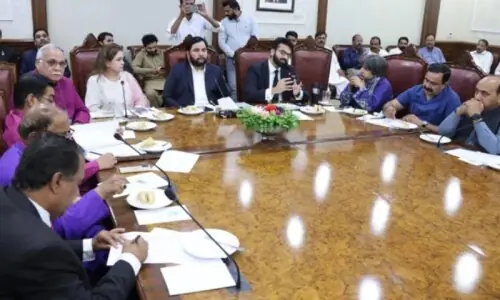
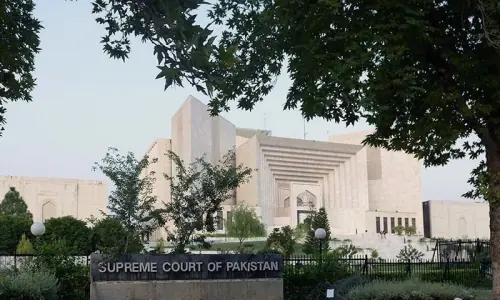
Being chairman of the NJPMC, Chief Justice Iftikhar Muhammad Chaudhry headed the meeting at the Lahore registry of the Supreme Court to discuss a request of the ECP regarding appointment of judicial officers as district returning officers and returning officers in the forthcoming general elections.
Federal Shariat Court Chief Justice Agha Rafiq Ahmed Khan, Balochistan High Court Chief Justice Qazi Faez Isa, Sindh High Court Chief Justice Mushir Alam, Lahore High Court Chief Justice Umar Ata Bandial, senior puisne judge of Peshawar High Court Justice Miftahuddin Khan and Islamabad High Court Chief Justice Iqbal Hameedur Rehman attended the meeting.
Addressing the meeting, the Chief Justice of Pakistan said a free and fair ballot ensured stability and took the nation towards prosperity. However, due to vested interest of different groups and corrupt practices the reputation of judiciary in the performance of election duties was at stake. Therefore, he said, at the time of formulating National Judicial Policy it was considered appropriate to keep the judiciary away from the elections process so that it could pay attention to clearing backlog and deciding pending cases.
The CJP stated that the judiciary valued the sentiments and confidence shown by the political parties, civil society and media in the judiciary and to play its role in the election process to enhance its credibility.
Taking up the request made by the ECP, the committee resolved that since the judiciary had taken great strides to strengthen its independence, therefore, before taking any decision regarding involvement of district judiciary in the election process, the Election Commission might be asked to explain as to how under existing section 7(5) of Representation of People’s Act, 1976, a judicial officer being returning officer could conduct election independently and effectively.
It observed that the role of district returning officer (DRO), returning officer (RO) etc in the selection of presiding officers and making appropriate changes in the polling stations to ensure free and fair election needed also to be explained.
The committee required the Election Commission to provide details of facilities to be made available to the DROs, ROs etc during the election process. Besides, provide details of arrangement made for logistics of the returning officers and other staff engaged in the election process. It further asked the ECP to explain measures taken for deweaponization of constituencies and security arrangements to hold the election in a free and fair atmosphere.
The committee also sought from the ECP the details of measures taken for capacity building and training of the ROs, DROs, presiding officers, polling staff etc. The committee required the commission to provide details of measures taken to check the possible pre-ballot and post-ballot rigging.
The CJP asked the NJPMC secretary (the SC registrar) to write a letter to Chief Election Commissioner.
The committee also considered the performance of district judiciary in the backdrop of National Judicial Policy and observed that maximum number of old cases had been decided.
After deliberations, the committee extended the target date for disposal of remaining old cases up to Dec 31, 2012. The CJP asked the chief justices of the high courts to monitor the performance of district judiciary for achieving the targets.
The committee discussed in detail the issues related to non-submission of challans and other issues ancillary to administration of criminal justice system. It was observed that non-completion of investigation and non-submission of challan was a major cause of delay in disposal of criminal cases.
The committee considered the statistics related to capacity of the prisons and existing strength of prisoners in jails and also considered the efforts of provincial governments to address the issue of overcrowding in jails.
It was observed that prior to implementation of NJP the population in jails was more than three times to the sanctioned capacity but now after implementation of the policy and expeditious disposal of cases the problem of overcrowding has been addressed to a great extent in the provinces of KPK, Balochistan and Sindh. It said a visible improvement has been noticed in the province of Punjab.
The committee also reviewed the data of offenders released on probation. It was informed that previously the law was not applied by the courts, however, after the implementation of the policy a good number of offenders had been released on probation by invoking the provisions of Probation of Offenders Ordinance, 1960.