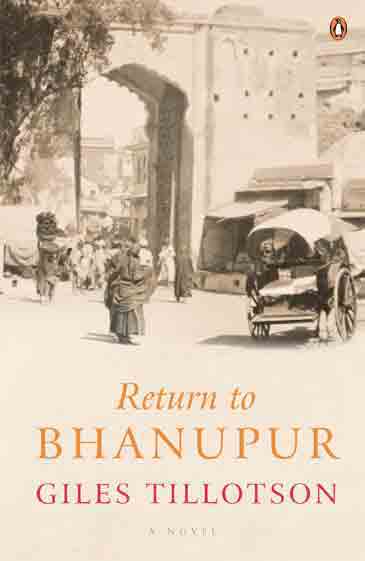
Return to Bhanupur is a novel which is, according to its author Giles Tillotson, a story “capturing the spirit of an Indian court at the turn of the last century.” Tillotson was a lecturer of Indian history at the University of London and now lives in Gurgaon near Delhi. He must have now acquired a more intimate knowledge of people and places than he probably did while studying Indian history. He has utilised this knowledge well by writing several books on the history of India. But the present work is his first attempt at fiction.
Elaborating his objective in writing this novel, Tillotson says that “Maharajas have not always had a good press in modern times. In the popular mind, the stock caricature maharaja was servile towards the British, neglectful of his duties, and given to self-indulgence and vice. I consider this conventional view to be partial and severe … and I have attempted in this novel to depict some of the challenges that confronted such rulers”.
And in that process, Tillotson has also revealed the thinking of the British officers working in India, particularly those posted in the princely states on various posts, including the residencies. In Return to Bhanupur, the Resident finds it frustrating to “give advice that no one pays any attention to and writing reports for the Viceroy’s council that nobody reads”. But everything changes when the maharaja dies, leaving a minor as his heir.
An interesting revelation made in the novel is that Urdu was then “the language of official business” in the Rajput princely states, and also that the chief commissioner for Rajputana was required to possess a fluency in the language.
One of the most difficult challenges faced by the maharaja in this story is his journey to England by sea for the purpose of attending the coronation of King Edward VII. According to a popular belief of the Hindus, a person could lose his caste by undertaking a journey by sea. However, the maharaja’s clever prime minister finds a way out.
Other challenges are also woven into the story. “Outsiders”, that is, those who are not natives of the state, occupy high positions. The most glaring example is that of Chatterji, a Bengali, who is the prime minister of that Rajputana state. Another matter of concern is the issue of a successor as the maharaja has not been able to produce an offspring from any of his wives. And to top all that, there is a demand for a legislative assembly where administrative matters could be discussed and debated.
The novel realistically describes the changing situation in princely states during the last decades of the 19th century and manages to keep reader interest intact.
Return to Bhanupur
(NOVEL)
By Giles Tillotson
Peguin Books, India
ISBN 9780143414285
184pp. Indian Rs250