0
0

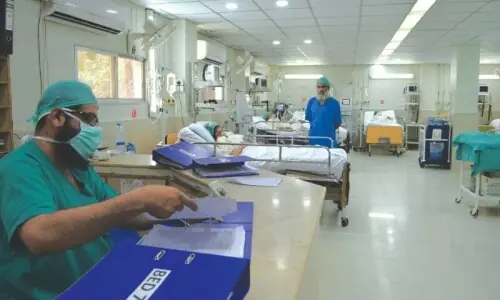
ISLAMABAD, Sept 25: The federal government has given the go-ahead to Pakistan Institute of Medical Sciences (Pims) to reopen its liver transplant centre which had been closed after the death of a patient about four months back, Dawn has learnt.
The transplant centre blocked the provision of live liver transplant services to the poor patients in May this year when a patient died because of alleged negligence during the post-transplant operation care.
It is pertinent to mention that liver disease is quite common in Pakistan and up to 12 per cent of the population is reported to be suffering from viral hepatitis.
A senior physician treating liver patients at a private hospital added that many of “these patients have end-stage liver disease for which the only treatment is transplantation.”
He said at such a point, patients are opting for transplantation in China and India with the treatment cost going up to Rs8 million and Rs9 million.
“However, the death rate continuous to remain high since the follow-up treatment is inadequate in Pakistan,” he maintained.
During a meeting with health officials recently, Prime Minister Raja Pervez Ashraf expressed concern over the rising number of poor liver transplant patinets and directed the Ministry of Capital Administration and Development to re-open the centre at Pims.
“We are not disappointed and will again venture into managing a successful operation and are again looking for international and Pakistani physicians to manage a poor liver transplant patient,” said an official of the ministry, who was part of the meeting chaired by PM Ashraf.
“The prime minister has agreed to fund the project and extend all the financial assistance needed by the centre,” said the official.
It may be mentioned that on Aug 11, 2011, the then Prime Minister Yousuf Raza Gilani had approved a financial support of Rs200 million for setting up of the liver transplant centre at Pims.
In the later stages, a UK-based team of experts was called in by the Pims management to manage a liver transplant procedure but due to some lacunas during the post-operation care, the patient died a few days later.
A private hospital physician during the same period managed two living donor liver transplant procedures managed by Dr Saud Dar, UK’s famous liver transplant surgeon.
However, the services of Dr Dar were ignored by the Pims management mainly because of pity politics as the hospital’s officials never approached him or his team at the private hospital at any stage during the transplant done in May.
But now the Pims management seems positive, saying they are ready to approach anyone to manage a successful living donor liver transplant.“This time we will seek assistance of any experienced physician, specifically Pakistani physicians working in the country or abroad, and we are ready to pay them the best package,” said a senior administration official of the hospital.
“We have decided to re-launch the liver transplant procedure and a meeting in this regard will be held in a week,” he added.
He said finances to manage the pre- and post-operation care of the patient and fee of the consultant physicians and liver transplant surgeon would be decided during the scheduled meeting.
The official said: “In case we are able to manage a successful live donor liver transplant procedure at Pims, we will be a major relief point for poor patients in the northern part of the country.”
Asked to comment on this year’s live transplant failure, he insisted: “We want the facility to be given to the poor in public hospitals and are willing to go to any extent to save the lives of an increasing number of poor patients.”