0
0

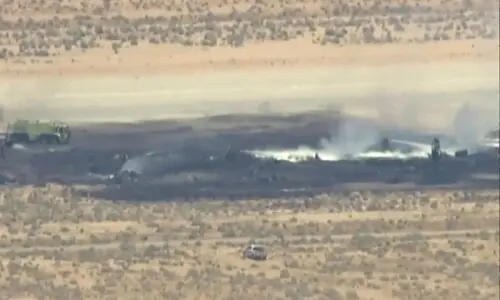
KARACHI: Four inquiry teams have been constituted by different institutions, a suo motu notice has been taken by the Sindh High Court chief justice and directives for ‘stern action’ have been issued by the governor against institutions responsible for the Karachi factory fire that killed at least 258 people on Wednesday, but not a single official has been blamed for negligence or dereliction of duty.
There are several unanswered questions about matters ranging from fire safety regulations, violation of rules, to professional capacity of rescue organisations.
A number of officials Dawn spoke to refused to be held responsible for implementing safety regulations and accused others of being negligent and inefficient.
“We have set up an inquiry committee comprising the commissioner of SESSI (Sindh Employees Social Security Institution) and labour director,” Sindh Labour Secretary Arif Elahi said.
“It has been given seven working days to establish whether the establishment was inspected by the officers concerned, whether health and safety measure were observed and also fix responsibility for negligence if there is any.”
The same response came from the commissioner of Karachi who had assigned two senior officials for almost the same job hours before Chief Minister Syed Qaim Ali Shah appointed Justice (retd) Zahid Qurban Alvi for a judicial probe into the tragedy.
Sindh police chief Fayyaz Leghari followed the trend and ordered the DIG of CID to lead three other senior officials in the investigation.
But with around 10,000 industrial units and five industrial estates across the city employing hundreds of thousands of labourers, the mandate for regulating fire and other safety measures in factories emerged as a serious question with multiple institutions supervising and controlling partial jobs.
“We mainly deal with issues relating to industrial areas’ infrastructure and facilitation services,” said Rasheed Solangi, Managing Director of the Sindh Industrial Trading Estate (SITE), which housed the gutted Ali Enterprises among 2,500 units in one of the largest industrial estates of the country.
Officials at the home ministry defended the department of civil defence (attached to the ministry) that ensures fire extinguishing facilities in commercial establishments and inspects the sites every three months.
“One can’t blame the civil defence purely for ignoring fire safety measures in the industrial units,” a senior official said. “There is always a chance of sparking fire despite all safety measures being in place but there is a serious question mark over the professional capacity and skills of the firefighting department that unfortunately remained much below the average standard.”
Amid the blame game, experts find little interest by the authorities concerned in setting up a dedicated fire safety regulatory body despite frequent incidents of fire mainly in Karachi’s industrial units over the past few years.
“There should be a fire engineering bureau,” said Tariq Moin of the Fire Protection Association. “We conveyed that thought several times to the authorities concerned and after every tragic incident the proposal gets some strength but fizzles out with the passage of time. The irony is that in the existing regulation system, you cannot fix responsibility on anyone; neither the industries can be bound to follow the defined rules.”
Some find the connivance between the stakeholders and the watchdog, compromising industrial workers’ lives but hardly motivating the authorities to intervene.
“Inspection of industrial units by the provincial labour department was mandatory under the rules until 1997 when it was banned after demands by influential industrialists in Sindh and Punjab,” Shujauddin Qureshi, a senior research associate at the Pakistan Institute of Labour Education and Research, said. Factory accidents claimed 419 lives in 2008, according to the latest data available, he said.