0
0

LAHORE, Aug 2: Planning and Development Department Chairman Mian Javed Aslam has renewed the Punjab government’s commitment to improving nutrition status of masses with a focus on women and children.
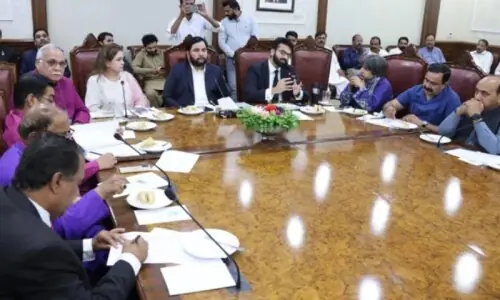
Speaking at a workshop organised on Thursday to develop multi-sectoral nutrition policy guidance notes for Punjab at a local hotel, he said there was a broad consensus globally on the Scaling up Nutrition (SUN) framework which indicates that first 1,000 days of life, from conception to the 24 months of a child’s life, determine a child’s learning and growth capability.
“Adequate nutrition at this stage of life ensures optimum productivity while malnutrition during this period results in illness, impaired cognitive development, school dropouts and overall loss of annually 2-3 per cent of GDP to economy,” Mr Javed said.
He said there was evidence that children were undernourished and multi-sectoral approach to fight menace of malnutrition could produce better results.
Punjab Health Secretary Arif Nadeem said NNS 2011 highlighted the fact that malnutrition issue had not been given due priority in past due to multiple reasons.
According to provincial nutrition analysis of the NNS, there is 39 per cent stunting, 14 per cent wasting and 30 per cent underweight children under the age of five, while among mothers there are 18 per cent underweight, 30 per cent overweight and 48 per cent suffering from anemia.
“These figures reflect the extremely poor nutrition status among women and children of the province,” Mr Arif said.
He said the integrated nutrition programme for Punjab was in the approval phase. The health department would allocate resources to improve nutritional status of women at pre-and-early pregnancy stages.
Micronutrient Initiative Country Director Dr. Tausif Janjua said: “It is important to understand that nutrition is not a standalone subject and needs to be addressed through multi-sectoral approach.”
Sharing the objectives of the workshop, he said the workshop would help develop common understanding among different departments and stakeholders to identify priority activities for addressing malnutrition. The linkage between policy and strategy will improve for operationalisation of integrated nutrition strategy.
He ensured full support of MI to the government of Punjab for addressing malnutrition.
Punjab Health Sector Reforms Programme (PHSRP) Project Director Farasat Iqbal said an inter-sectoral coordination committee had been formed under the umbrella of planning & development department that would assist the Punjab government in developing multi-sectoral policy note for addressing malnutrition.
P & D Secretary Ali Tahir ensured that legal framework would be strengthened to ensure compulsory salt iodization and wheat flour fortification with iron. He also endorsed the commitment of the Punjab government for formulation of policy based on the recommendation of this workshop.
Nutrition Planning Commission Senior Chief Muhammad Ayub said the provincial autonomy after 18th amendment gave provinces a big opportunity and Balochistan and Sindh had already started work on their nutrition strategies. The senior representatives from public sector departments including education, law, food, fisheries, finance, public health engineering, agriculture, Benazir Income Support Programme, social welfare, local government, bureau of Statistics department, Universities of Agriculture Faisalabad, University of Veterinary & Animal Sciences Lahore, donor organisations including World Bank, Micronutrient Initiative, WHO, Unicef, Save the children, WFP, TRF, GAIN, DFID & FAO attended the workshop.