BANGKOK: Communal violence is continuing in western Myanmar six weeks after the government declared a state of emergency there, and much of it is being directed at minority Muslim Rohingyas who have been beaten, killed and raped, Amnesty International said Friday.
The rights group accused both security forces and ethnic Rakhine Buddhists living in the region of carrying out fresh attacks against Rohingyas, who are seen as foreigners by the ethnic majority and denied citizenship by the government because it considers them illegal settlers from neighboring Bangladesh.
After a series of isolated killings starting in late May that left victims on both sides, bloody skirmishes quickly spread across much of Myanmar's coastal Rakhine state. The government declared a state of emergency June 10, deploying troops to quell the unrest and protect both mosques and monasteries.
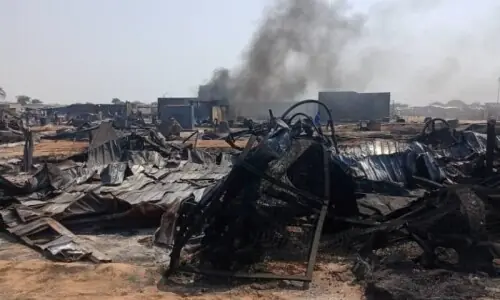
The worst of the violence subsided two weeks later, and authorities said at least 78 people were killed and thousands of homes were burned down or destroyed — with damages roughly split evenly between Buddhists and Muslims.
Since then, communal violence has ground on, albeit at reduced intensity. But now, Amnesty said, attacks are mostly being directed at the Rohingya population.
Violence in the last six weeks has been ''primarily one-sided, with Muslims generally and Rohingyas specifically the targets and victims,'' Benjamin Zawacki, a Bangkok-based researcher for Amnesty, told The Associated Press.
''Some of this is by the security forces' own hands, some by Rakhine Buddhists with the security forces turning a blind eye in some cases.''
Officials from Myanmar's government could not immediately be reached for comment.
Amnesty also said that security forces, including the police and the army, have conducted massive sweeps and detained hundreds of Rohingyas who are being held ''incommunicado.''
''While the restoration of order, security, and the protection of human rights is necessary, most arrests appear to have been arbitrary and discriminatory, violating the rights to liberty and to freedom from discrimination on grounds of religion,'' Amnesty said in a statement.
The violence, which reached its bloodiest point in June, constituted some of the country's deadliest sectarian bloodshed in years and raised international concerns about the Rohingyas fate inside Myanmar.
President Thein Sein said earlier this month that the solution to ethnic enmity in Rakhine state was to either send the Rohingya to a third country or have the United Nations refugee agency look after them.
UNHCR chief Antonio Guterres said, however, that it was not his agency's job to resettle the Rohingya.
Many people in Myanmar don't recognise Rohingya as legitimate settlers — even those of Bengali heritage who came in the 19th century, when Myanmar was under British rule and called Burma.
Large exoduses of Rohingya to Bangladesh in the 1980s and 1990s because of persecution, and their subsequent return, also add to the confusion over who among them are illegal immigrants.
Bangladesh, for its part, also denies the Rohingya citizenship, arguing that they have been living in Myanmar for centuries and should be recognised as citizens there instead.
The UN estimates that 800,000 Rohingya live in Myanmar today. Thousands attempt to flee every year to Bangladesh, Malaysia and elsewhere in the region, trying to escape a life of abuse that rights groups say includes forced labour, violence against women and restrictions on movement, marriage and reproduction that breed anger and resentment.
Amnesty called on Myanmar to accept the Rohingya as citizens, something the government has staunchly opposed because it does not consider them an ethnic group native to Myanmar.
''Under international human rights law and standards, no one may be left or rendered stateless,'' Zawacki said. ''For too long Myanmar's human rights record has been marred by the continued denial of citizenship for Rohingyas and a host of discriminatory practices against them.''