0
0

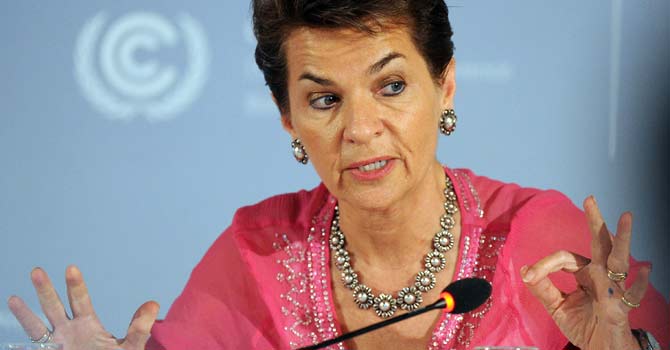
BONN: Less than six months after the world agreed to craft a new global climate pact by 2015, talks stumbled at a crucial preparatory phase Friday as rich and poorer countries butted heads.
With the mood still strained by the 2009 Copenhagen climate summit, negotiations in Bonn showed developed and developing nations split on apportioning responsibility for tackling global warming.
Fast-growing countries like China and India insisted the West, which has been polluting more for longer, must shoulder more of the mitigation burden.
Amid fresh delays and procedural wrangling, UN climate chief Christiana Figueres warned the target of pegging global warming to a manageable 2 degrees Celsius seemed to be slipping ever further away.
“Current efforts on mitigation are not sufficient, and the doors on improving the probabilities of a maximum two degrees are actually closing in on governments,” she said.
It took the 180-odd countries grouped in the former German capital all of 11 days to agree on a work plan for the ADP – the body that will lead negotiations for a new post-2020 global pact to curb greenhouse-gas emissions.
China and other like-minded countries objected to including pre-2020 emission targets in the ADP’s agenda.
“It was not easy issue to agree,” Figueres said, adding that “all parties needed reassurances from each other.”
Despite this small step forward, countries remained split on a chairperson for the new body.
China and its allies wanted India to chair the ADP, arguing it is the Asia-Pacific bloc’s turn to steer a subsidiary body under the UN Framework Convention for Climate Change (UNFCCC).
The other candidates are Norway and the Caribbean state of Trinidad and Tobago.
The United States and Europe accused others of obstruction, and China fought back against accusations that it was to blame.
“There is a kind of division in the room, a small group holding up what the rest of the room does,” European Commission chief climate negotiator Arthur Runge-Metzger told journalists of the countries he said included China.
“We were disappointed and frustrated that discussions at this meeting focused largely on procedural issues,” added US negotiator Jonathan Pershing.
On Thursday, China rejected accusations by Western delegates that it was holding up progress, insisting it was the United States, Europe and other rich states seeking to “evade legally binding commitments”.
Under the Kyoto Protocol on climate change, whose first leg ends this year, 37 industrial countries are held to specific goals for slashing greenhouse gas emissions.
Poorer countries have no binding targets, but this could change under the deal struck in Durban, South Africa, last year to draw up a new global pact within four years.
“We need to move into a system reflecting modern economic realities,”insisted Danish climate negotiator Christian Pilgaard Zinglersen – “a system that has a spectrum of commitments for countries, the scope and nature of which will vary according to a particular country’s capabilities.”
China is by far the world’s number one carbon emitter and its 1.3 billion people are swiftly getting wealthier, causing the country to burn ever more coal, gas and oil.
On Thursday, German climate researchers said the planet was on a track for warming by more than 3.5 degrees Celsius, boosting the risk of drought, flood and rising seas.