0
0

WASHINGTON: North Korea has undertaken a major upgrade of a launch pad that could pave the way for longer-range missiles, a research group said Tuesday, amid mounting concern over Pyongyang’s nuclear program.
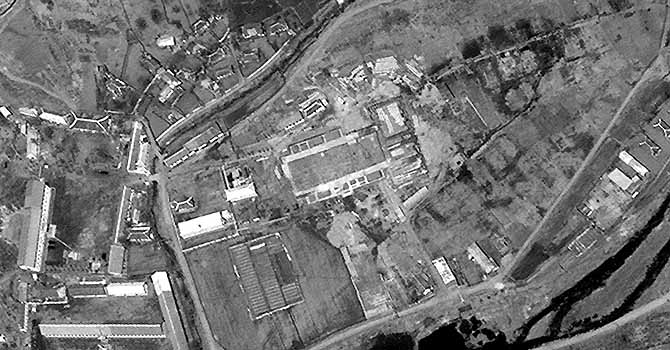
Satellite images show that North Korea has made “rapid progress” in the past year at its Musudan-ri site and has apparently razed a nearby village for a building to assemble larger rockets, according to the US-Korea Institute at Johns Hopkins University.
The institute suspected that North Korea was looking at rockets larger than its Unha-3, which flopped during an April 13 test, and that may have intercontinental range, a longstanding concern of the United States.
“The new construction is intended to support future launches of rockets larger than the recently tested Unha, more capable liquid fueled space launch vehicles or missiles with intercontinental ranges, that will also overfly Japan, further aggravating regional tensions,” the institute said on its blog, 38north.org.
The researchers estimated that the upgraded center would be operational by 2016-2017. The pictures showed a flame trench, foundations for buildings and a white circular structure whose purpose is unclear but will likely surround erected rockets.
The institute said that the facility had similarities but also differences with a launch complex in Iran and said it was uncertain whether there was cooperation between the two countries, both nemeses of Washington.
North Korea stunned the world in 1998 when it fired a rocket over Japan into the Pacific Ocean. Its recent tests have been less successful, with even North Korea’s normally triumphant media acknowledging the latest launch was a failure.
North Korea said that last month's launch, carried out from Sohae, a separate station, was a bid to put a satellite into orbit. But US and allied nations believe that North Korea was fine-tuning a long-range missile.
The communist state has since hinted that it will carry out its third nuclear test.
A foreign ministry spokesman on Tuesday threatened “counter-measures for self-defense” if the United States “persists in its moves to ratchet up sanctions and pressure upon us despite our peace-loving efforts.”
The spokesman was hitting back at a statement Saturday by the United States and other members of the Group of Eight major industrialized nations that said they would press for UN action in response to further launches or a nuclear test by North Korea.
The United States already suspended a February 29 agreement to provide badly needed food assistance to North Korea in response to the rocket launch.
Glyn Davies, the US special envoy on North Korea, played down the latest North Korean statement during a visit to Beijing, saying it did not represent a change of stance by Kim Jong-Un’s regime.
He called for North Korea to recommit to a six-nation 2005 agreement under which it agreed to end its nuclear program in return for aid and security guarantees.
“What we're looking for now from North Korea is that they will now begin to take actions to demonstrate that they are serious about fulfilling their promises,” Davies said.
The US-Korea Institute, releasing analysis of separate satellite pictures taken last month, earlier said that North Korea also appeared to be making headway on a light-water reactor that could support its nuclear weapons program.