



 3
3

Paisay Da Nasha by Bohemia: Award-winning Pakistani-Amerian rap artiste Bohemia’s Paisay Da Nasha carried his signature both lyrically and in terms of its flow. The Viccaji sisters (Racheal and Zoe) joined him on stage to return this season as backing vocalists.
“Behind every rap song and its poetry is a message,” said Bohemia in the behind-the-scenes clip. Unsurprisingly, he was talking about the intoxication that the pursuit of money brings. “I’m asking a question in the song, and perhaps I’m asking myself: did you get any real happiness from doing that?”
Coke Studio experimented with Bohemia’s song by infusing and bringing to the forefront a variety of instruments. It worked well except for one little thing—the music often pushed Bohemia’s singing into the background whereas he deserves to be front and centre all the way through.
Tum Kaho by Symt: “This song is for a very special person in my life,” said Haroon Shahid, lead singer and songwriter for Symt. Guitarist Hassan Omar composed and arranged the music and played it for Haroon who penned the lyrics. Perhaps the most surprising revelation is that the guitarist’s inspiration when composing music comes from video games.
Tum Kaho is an expression of the one human emotion that can bring about both war and peace—love—in its most absolute form. It is not a new song for ardent Symt fans as they have performed it numerous times. The CS version changes but doesn’t eliminate its funky nature and adds an almost jazzy element to it.
Kamlee by Hadiqa Kiyani: Kamlee is a kalam penned by the popular Punjabi Sufi poet, Baba Bulleh Shah. It has been covered by numerous artistes and deals with a recurring theme in his poetry: introspection that leads to a greater awareness of the self.
Hadiqa rendered Kamlee with such feeling that in the place of the singer who sang popular love ditties some 20-odd years ago emerged a mature woman who sang a kalam deeply rooted in the very fabric of society. She sang with an angst and a darkness never seen before. “Kamlee has my heart and soul in it,” said Hadiqa.
Larsha Pekhawar Ta by Humayoon Khan: A request made by a woman to her lover to bring her a black tunic and four flowers from Peshawar forms the base of this classic Pashto folk song. The origins of Larsha Pekhawar Ta are unknown but it is a song that is stamped deep into Pakhtun culture. Many artistes have covered it with an Urdu version, Tujh Ko Qasam Hai Meri, existing as well.
“Performing this song has been an enchanting experience,” said Humayoon Khan. “Larsha Pekhawar Ta has a very high value for us Pakhtuns. I’m proud to be the first such singer representing our music and culture on CS. Perhaps next time, I’ll present some of my original songs.”
Humayoon Khan teamed up with rabab player and CS regular, Sadiq Sameer, and sang the song to perfection—so much so that Sikandar Mufti, in the behind-the-scenes clip, gave into the song and could be seen dancing away.
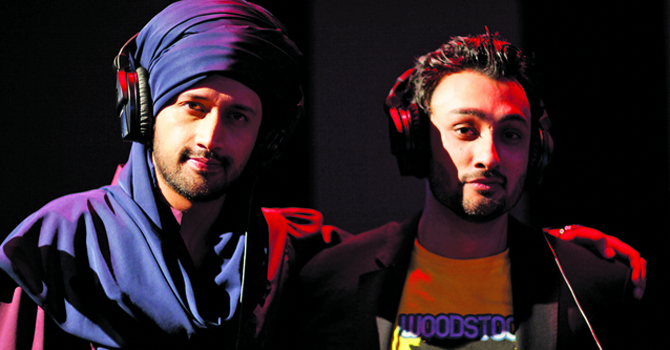
Charkha Nolakha by Atif Aslam and Qayaas: At Qayaas band member Sarmad Ghafoor’s suggestion, who is also the guitarist for Atif Aslam’s backing band, Atif and Qayaas decided to collaborate. Atif’s intent was to help out some of the newer talent emerging in Pakistan’s music industry.
According to Atif, “We initially wanted to perform Sun Charkha Di Mithi Mithi by Nusrat Fateh Ali Khan (NFAK) so we shared our version of the song with Rohail Hyatt.” The producer, however, felt that Charkha Nolakha (also by NFAK) would be a better option.
According to the Qayaas’ lead singer, Umair Jaswal, “Working with Atif Aslam was a fantastic experience. He is a master of improvisation and has the ability to reproduce musical pieces that sound pleasing to the ears.”
With the idea of paying tribute to some of the biggest names in Sufi and rock music, the idea of fusing NFAK’s music with Led Zeppelin came into existence. “Initially I was supposed to sing the verses of Kashmir (Led Zeppelin) at the climax of the song but the idea was changed.” Instead, Umair sang the opening lines of a kalam by Bulleh Shah on the guitar riff of Kashmir.
East meets west in Charkha Nolakha in a symphony that is both raw and haunting. It presents itself like an intimate ballad and flows like a whispered conversation between two very powerful entities coming together with a common purpose. Umair Jaswal holds his ground in Charkha Nolakha as Atif Aslam’s contemporary—his equal—while as a seasoned performer, Atif instinctively knows how to steer the mood of the song in a way that suits it best. It was a befitting end to a fantastic start to the fifth season of Coke Studio.


























