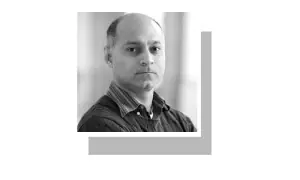
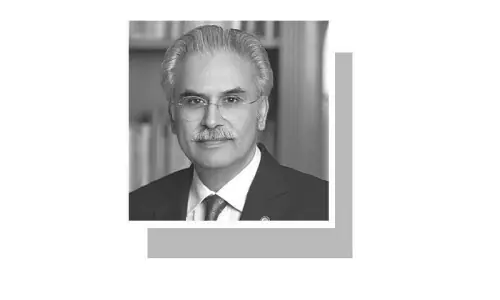
He is eloquent. He is an engaging conversationalist. He is a poet, in the words of Yuvgeny Yevtushenko, whose poetry is his autobiography. Isn’t that enough to make a person have an exalted position in a society which is getting intellectually bankrupt by the minute? Perhaps not. Perhaps yes. Does Iftikhar Arif care? Perhaps yes. Perhaps not.
(Mind, toy not with passion or frenzy/ Eyes, be set on livelihood alone)
People think that Iftikhar Arif loves Mir Taqi Mir to bits. It’s true. This, however, does not imply that he does not hold Mirza Asadullah Khan Ghalib in high esteem. He is not torn between the two giants. He acknowledges the worth of both the masters in equal measure. So there must’ve have been a cogent reason for writing a line in one of his ghazals which some misconstrued not respectful enough to Ghalib.
“That was just a poetic thing. Ghalib is unmatched. You know Firaq had a teacher who once said, ‘As a qaseeda writer Sauda and Zauq excelled Ghalib; as a ghazal writer Mir and Momin excelled; but as a poet Ghalib excelled them all.’”
Iftikhar Arif was born on March 21, 1944 in Lucknow. The date is not as significant as the city of his birth. He, even after turning 68, remembers it with fondness that borders on anguish. The poet may not want to give off that feeling or realise that. The fact is he misses Lucknow sorely.
“Lucknow is a mazloom (oppressed, exploited) city. I still remember the frequency with which mahafil-e-sama and majaalis were organised in Lucknow. One mehfil-e-sama spot was right next to a mosque. You can imagine the environment. Persian poetry would be regularly recited. Therefore no one could escape that ambience. We used to get books as gifts at debating events. My mother had saved a great many books for me. Madressah-e-Nizamia was opposite our house and I would often visit it whenever I felt like it.
“The Lucknow that I’m referring to was the Lucknow of Jaffer Ali Khan, Syed Ali Naqvi, Asar Lucknavi, Yagana Changezi, Majaz, and Sajjad Zaheer. Akhtari Bai Faizabadi lived there. People belonging to Wajid Ali Shah’s family were there too, as were students and members of Birju Maharaj. It was the Lucknow of the Anjuman Taraqqi Pasand Musannafeen (progressive writers). Cities get rebuilt after being destroyed, not Lucknow. In 1936 the first Progressive Writers Conference was held in that city. The delegation that came from Punjab to take part in the moot had a certain Faiz Ahmed Faiz in it, apart from Rasheed Jahan and Mehmooduzzafar.”
Once Iftikhar Arif begins reminiscing about Lucknow, it is very difficult to bring his train of thoughts to a halt. It is not nostalgia. It is love, unconditional love, for a place that’s an integral part of his being.
“My step maternal grandfather took care of me most. I joined Lucknow Christian School and then later Lucknow Jubilee College. While I was graduating I had teachers like Dr Mukerjee (who taught philosophy of knowledge) and Dr Majumdas (who taught cultural anthropology). At the age of 21 I had already done my masters in social sciences.”
(Flurries entangle my hair, even as yet/ I have to pay back the debt of time)
Being a versifier himself, for sure, there must have been a poet from Lucknow who initially inspired Iftikhar Arif.
“The first poet that I liked was Majaz.”
And the first girl that he fell for?
“I did not have time for falling in love. My family was not well-off. I had become accustomed to reading and visiting libraries. To this day I’m like that. I have never made any house for myself either.
“Tell you an interesting story. During my childhood I befriended a couple of kids who were a washerman’s sons. They used to take my clothes in the evening to their ghaat and wash them. So I never wore dirty clothes. The first suit that I ever put on was when I went to take part in the BA convocation.”
When Iftikhar Arif speaks, you know you are not listening to someone who does not know his onions. He is dead right when he says that from a very early age he became a bookworm.
“There was no method to my reading. French literature, Russian novels, Urdu poetry… I would read them all, and sometimes simultaneously. But none of these disciplines could help me earn money.”
(The desire for comfort and ease consumed me/ I could have gone far, farther still)
It has to be understood that despite missing Lucknow, Ifitkhar Arif is a die-hard Pakistani. He relishes the thought that he migrated to Pakistan for that was one of the most apt decisions that he has taken in his life.
“If I get a chance to migrate to Pakistan again, I’d do that. Those who stayed back in India during partition know better what price UP’s Muslims had to pay for the creation of Pakistan. Urdu and UP had to pay heavily for partition. Pakistan is a blessing.”
All of this sounds true and impressive, just like Iftikhar Arif’s extraordinary talent. There’s a reason he, besides being a top-drawer poet, became a senior producer at PTV when he was 23. At 31 he was serving the Urdu Markaz. Subsequently, he headed reputed institutions like the National Language Authority, and is now a visiting professor of the Hindi and Urdu departments of the National University of Modern Languages. And yet, there’s an air of solitude about him. How is that possible?
(The heart shivers from the terror of reckoning/ Sinking, that time shall not be extended)
“Artists are fated to be alone (tanhaee fankar ka muqaddar hai). The mediocre exist amidst crowds. In the final analysis we are all alone. This solitude or loneliness provides food for thought. In the entire course of my life there has not been a single soul who could blow me away (koi bhi aisa shakhs nahin hai jo mujhe baha le jata). There were two or three women who did come into my life, and I respect them.”
(Is the tale mysterious or made so?/ We'll know when it all ends)
“After I’m done writing a poem or a ghazal, I get more worried. When I now read my poem Barhvan Khilari I feel saddened by it.”
And yet, what triumphs is the power of creativity, the force of eloquence. Iftikhar Arif’s unmatched poetry accepts life, warts and all.
(The pen digs into bread and butter but I/ Wish to keep it as free as I possibly can).