0
0

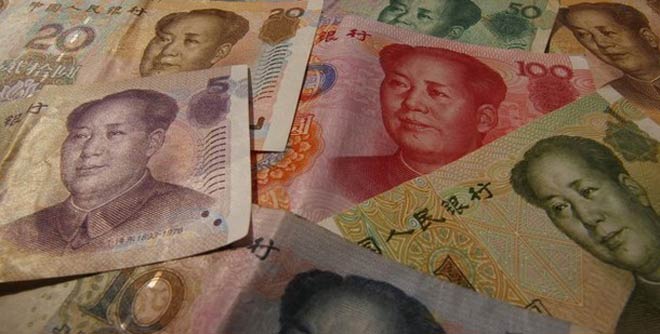
SHANGHAI: China's yuan weakened against the dollar on Monday, the first trading day after a landmark move by Beijing aimed at liberalising tight controls over the currency that have angered trade partners.
The People's Bank of China said Saturday the unit would be allowed to fluctuate by 1.0 percent above and below a daily midpoint -- double the previous 0.5 percent -- giving the currency more flexibility.
Analysts said the move paved the way for more financial reforms aimed at even greater flexibility in the yuan, which many of China's trading partners say Beijing keeps artificially low to maintain a competitive export industry.
“The time is ripe for China to carry out certain reforms, and we think the government may launch a series of financial reforms to increase the flexibility of the exchange rate,” Sun Junwei, macro-economic analyst at HSBC, told AFP.
Chinese leaders have repeatedly pledged to make the tightly-controlled exchange rate more flexible as a step towards allowing the yuan to become freely convertible.
“There has been a flurry of recent reforms affecting the (yuan) and the broader financial sector, all of them pointing in the direction of more liberalisation,” said Mark Williams, chief Asia economist for Capital Economics.
“The wider band lays the groundwork for a more market-driven and volatile exchange rate regime somewhere down the road,” he said in a research note.
On Monday, the central bank set its trading midpoint at 6.2960 yuan to the dollar, weaker than Friday's central parity rate of 6.2879, the People's Bank of China said.
In afternoon trade, the yuan stood at 6.3159 to the dollar against Friday's close of 6.3030, with the Chinese currency weakening on worries over the country's slowing domestic economy.
The yuan has risen more than eight percent against the dollar since Beijing in June 2010 relaxed a de-facto peg to the US currency, imposed in 2008 to protect its exporters during the global financial crisis.
Analysts say the wider trading band indicates confidence among policymakers that the currency will not appreciate sharply, despite anger among major trading partners over what they say is still a very weak yuan.
Many in Washington believe the unit is still undervalued by as much as 30 percent.
“The consensus in Beijing is that the room for (yuan) appreciation seems quite limited,” said Lu Ting, China economist for Bank of America.
“With a falling trade and current account surplus, external pressure on China to appreciate... has been alleviated,” he said in a report.
China and the United States in particular have been locked in a dispute over the value of the yuan, which US politicians claim is costing US jobs due to a huge trading gap between the two countries.
The US ambassador to China, Gary Locke, last month urged Beijing to end its “unfair” currency policies.
But China's trade surplus narrowed to $155.14 billion last year from $181.51 billion in 2010, and is expected to shrink even further this year, giving critics less ammunition to criticise China over the yuan.
The currency is still widely expected to appreciate this year, though at a slower pace than in 2011, when the unit gained more than five percent.
Nomura Global Economics said the latest move was a “genuine reform” but noted the change came before a key China-US economic meeting, when Washington could pressure Beijing over the currency issue.