



 0
0

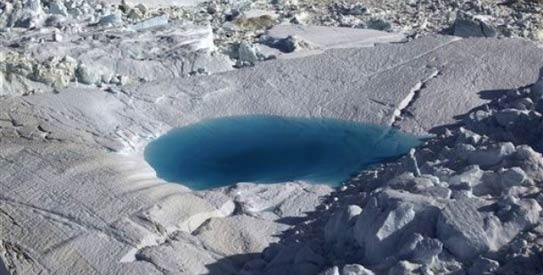
PARIS: The Greenland icesheet is more sensitive to global warming than thought, for just a relatively small -- but very long term -- temperature rise would melt it completely, according to a study published on Sunday.
Previous research has suggested it would need warming of at least 3.1 degrees Celsius (5.6 degrees Fahrenheit) above pre-industrial levels, in a range of 1.9-5.1 C (3.4-9.1 F), to totally melt the icesheet.
But new estimates, published in the journal Nature Climate Change, put the threshold at 1.6 C (2.9 F), in a range of 0.8-3.2 C (1.4-5.8 F), although this would have to be sustained for tens of thousands of years.
Greenland is second to Antarctica as the biggest source of locked-up water on land. If it melted completely, this would drive up sea levels by 7.2 metres (23.6 feet), swamping deltas and low-lying islands.
If global warming were limited to 2 C (3.6 F), a target enshrined in the UN climate-change negotiations, complete melting would happen on a timescale of 50,000 years, according to the study.
Current carbon emissions, though, place warming far beyond this objective. If they were unchecked, a fifth of the icesheet would melt within 500 years and all would be gone within 2,000 years, the study says.
The probe is authored by scientists from the Potsdam Institute for Climate Impact Research (PIK) and the Universidad Complutense de Madrid.
They say that the risk of total loss may seem remote, given the immense timescale. But they also warn that their findings challenge many assumptions about the icesheet’s stability in response to long-term warming.
Earth’s atmosphere has already warmed by 0.8 C (1.4 F) since the start of the Industrial Revolution in the mid-18th century, and carbon dioxide (CO2) that is being emitted today will linger for centuries to come.
The icesheet is vulnerable to a kind of vicious circle, also known as a positive feedback, that cranks up the melt, according to the paper.
Reaching over 3,000 metres (10,000 feet) thick in some places, the icesheet today benefits from the protective effect of higher, cooler altitudes.
But when it melts, the surface comes down to lower altitudes which have higher temperatures, and this accelerates the cooling, the computer models show.
In addition, patches of land that become exposed by ice absorb solar radiation because they are darker and do not reflect the light. As they warm up, they in turn help melt the ice nearby.
“Our study shows that under certain conditions the melting of the Greenland ice sheet becomes irreversible. This supports the notion that the icesheet is a tipping element in the Earth system,” says PIK researcher Andrey Ganopolski.
“If the global temperature significantly overshoots the threshold for a long time, the ice will continue melting and not regrow -- even if the climate would, after many thousand years, return to its pre-industrial state.”


























