0
0

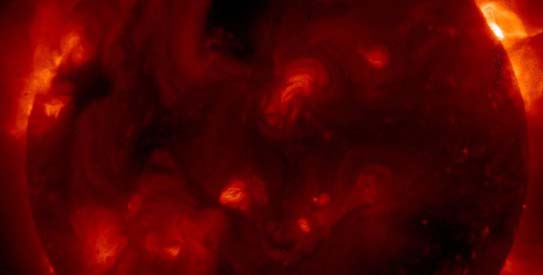
WASHINGTON: The largest solar flare in five years is racing toward Earth, threatening to unleash a torrent of charged particles that could disrupt power grids, GPS and airplane flights.
The sun erupted on Tuesday evening, and the effects should start smacking Earth around 7 am EST on Thursday (1200 GMT), according to forecasters at the federal government’s Space Weather Prediction Centre. They say the flare is growing as it speeds outward from the sun.
“It’s hitting us right in the nose,” said Joe Kunches, a scientist for the National Oceanic and Atmospheric Administration.
The solar storm is likely to last through Friday morning, but the region that erupted can still send more blasts toward Earth, Kunches said. He said another set of active sunspots is ready to aim at Earth right after this.
But for now, scientists are waiting to see what happens on Thursday when the charged particles hit Earth at 4 million mph.
Nasa solar physicist Alex Young added, “It could give us a bit of a jolt.” But he said this is far from a super solar storm.
The storm is coming after an earlier and weaker solar eruption happened on Sunday, Kunches said. This newer blast of particles probably will arrive slightly later than forecasters first thought.
That means for North America the “good” part of a solar storm, when it creates more noticeable auroras or Northern Lights, will peak on Thursday evening and Friday morning. Auroras could dip as far south in North America as the Great Lakes, along the Canadian border, or lower, Kunches said, but a full moon will make them harder to see.Auroras are “probably the treat we get when the sun erupts,” Kunches said.
But there is the potential for widespread problems. Solar storms have three ways they can disrupt technology on Earth: with magnetic, radio and radiation emissions. This is an unusual situation when all three types of solar storm disruptions are likely to be strong, Kunches said.
That means “a whole host of things” could follow, he said.
The magnetic part of the storm has the potential to trip electrical power grids. Kunches said power companies around the Earth have been alerted for possible outages. The timing and speed of the storm determines whether it will knock off power grids, he said.
In 1989, a strong solar storm knocked out the power grid in Quebec, causing 6 million people to lose power.
Solar storms also can make global positioning systems less accurate, which is mostly a problem for precision drilling and other technologies, Kunches said. There also could be GPS outages.
The storm can cause communication problems and bring added radiation around the north and south poles, which probably will force airlines to reroute flights. Some already have done so, Kunches said.—AP