0
0

LAHORE, March 7: Pro-women legislation is a revolutionary measure in the parliamentary history of Pakistan which can emancipate women if a strong and effective implementation mechanism is developed.
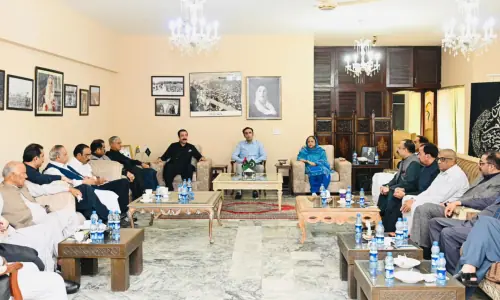
This was a consensus among speakers of a seminar ‘Struggle of Women Parliamentarians for Pro-Women Legislation’ by South Asia Partnership-Pakistan to celebrate World Women’s Day on Wednesday.
Speakers suggested some effective planning for women to have access to justice and take full advantage of new laws. They demanded that the Punjab government prepare an implementation mechanism to give some teeth to the new laws.
MPA Samia Amjad said new laws on domestic violence would empower women in their homes. She said civil society had raised awareness among the public on women’s issues.
MPA Sajida Mir said the controversial Hudood Ordinance and Qisas and Diat laws had let down women in society but the recent legislation would help women regain their status.
Lawyer Rabia Bajwa spoke on Anti-Women Practices (Criminal Law Amendment) Act of 2011, Acid Control and Acid Crime Prevention Act of 2010, and Women in Detention Fund Act 2011.
Human Rights Commission of Pakistan Secretary-General IA Rehman congratulated women parliamentarians on the passage of pro-women laws calling it a breakthrough in Pakistan’s parliament history. He said though women faced a lot of resistance in assemblies, they should continue their struggle until some implementation mechanism was developed.
Justice Nasira Javed Iqbal (retired) said there was no women’s representation in the Election Commission of Pakistan. She also spoke on domestic violence calling it a heinous crime. She urged provincial assemblies to pass laws on domestic violence with the implementation mechanism package.
Mohammad Tahseen, executive director of the South Asia Partnership–Pakistan, said civil society always supported the struggle for women’s rights. The credit goes to women legislatures, he said.
WISE SEMINAR: At another seminar, speakers spoke highly of parliamentarians for passing women-related legislation unanimously.
The seminar titled ‘Playing like a Team – Strategies for Young Leadership’ by Women in Struggle for Empowerment (WISE) was held at Lahore Press Club.
WISE Executive Director Bushra Khaliq said women, particularly girls, possess great potential which needed to be explored. She said various factors were limiting women’s potential to aspire to positions of leadership.
The constraints that women face are the patriarchal system where decision making powers are in the hands of males. In the Pakistani context, traditional cultural attitudes regarding the role and status of women in society are still prevalent and women who are part of this system finding it difficult to dislocate from this culture lest they be ostracized.
Democratic Commission for Human Development Executive Director Tanveer Jehan said the concept of leadership has always carried the notion of masculinity and the belief that men make better leaders than women is still common today. Although the number of female leaders has increased in Pakistan, they are often named as an afterthought. The societal conventions regarding gender and leadership traditionally exclude women, and top leadership is viewed as a masculine domain. The cultural construction of leadership in itself instigates difference and this is only now being transformed as some women gain access to leadership positions.
Mumtaz Mughal of Aurat Foundation said stereotype social behaviors are prevalent in our public life that is very hard to overcome. Young women might not only lack support of their families for their participation in active social life or politics, but also face criticism and serious repercussions from society in general. In some cases, such resistance to women’s political participation results in violence against women, including brutal beatings and even killings.
Aima Mehmood, executive director of Working Women Organization, said traditional beliefs and cultural attitudes regarding the role and status of women in society are still prevalent. Despite women’s education and entry into the job market, the woman’s role is typically one of homemaker. Confining women to the domestic sphere is one of the barriers to their entry into politics and politics by its nature catapults one into public life.
Shaheena Kausar, general secretary of Working Women Union, said besides elderly women a number of young girls were doing home-based work to supplement family income. She urged the government to introduce social protection systems for the protection of labour rights of these poor home-based workers Nida Kirmani, a researcher and teacher at LUMS, said in Pakistan traditional educational institutions have norms and values encouraging a dominant male society. When women join such institutions as leaders, they soon realize that they are expected to assimilate to the established culture. Not many have seen the irony in our recent Oscar win over a documentary film about acid-throwing incidents in the country, majority of them not in tribal backwaters but in big urban centers, she said.
Naumana Suleman of the National Commission for Justice and Peace said state priorities must include special initiatives for poor and minority women. On this occasion a group of young girls presented songs, specially prepared for the women day.
The seminar was followed by a colorful rally, participated by a large number of women and girls.