KARACHI, Feb 12: With fewer literary heavyweights on the schedule and a smaller crowd, day two of the Karachi Literature Festival did not bring the increased attendance and excitement one would have expected on a Sunday.
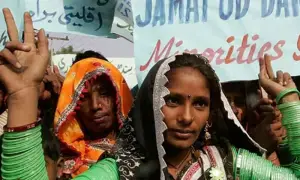
The first day had set the bar high, with the introduction of a number of international literary stars. And many of Sunday’s themes were more serious, with panels on the separation of East Pakistan, minorities, Pakistan’s nuclear strategy and the psychological effects of terrorism.
But challenging the stereotype of Pakistanis having a bottomless appetite for sombre political analysis, the highlight of the day — and perhaps of the entire festival, according to some attendees — were Ali Aftab Saeed of the Beyghairat Brigade and Saad Haroon talking about, and performing, satire and comedy.
“It was the best panel at this year’s festival,” said writer Bilal Tanweer. “First, they were genuinely funny. Second, they were talking about all the sacred cows, the army, the ISI, the judiciary. They made it clear that the purpose was not to be didactic but to create a space through satire where people can talk about this stuff openly.”
The two comedians had the crowd in stitches as they targeted political actors and developments, providing a welcome break from other sessions in which the audience’s energy was palpably low.
A handful of events did manage to spark debate. In a panel of foreigner journalists and authors who write about Pakistan, audience members repeatedly questioned them about failing to represent the ‘good’ side of the country. And veteran Indian journalist Hartosh Bal Singh vehemently criticised his own country’s media for biased coverage of Pakistan, with writer Alok Bhalla adding that it is “schizophrenic and hysterical”.
“The Jaipur Literature Festival is much bigger in terms of scale and scope, but what’s comparable is the energy,” said novelist and panellist Shehryar Fazli. “The rooms have been packed, the conversations have been both adversarial and friendly, and as you walk from one room to another you bump into people whose work you’ve been following.”
In his closing remarks, writer Hanif Kureishi talked about the impression he was leaving with of a society eager to talk about its problems. “I’ve been to a lot of festivals, but this one had a real sense of urgency. When you tell people you’re going to Pakistan they think it’s the worst place in the world, but I’ve been very impressed by the desire of people to speak.”