



 0
0

Rewind to the early 1970s, a time when our finance and policy planners were, apparently, more visionary.
Pakistan was still a young country and financial allocations for social sector development were in the range of seven per cent of GNP. All essential sectors were addressed as extensively as possible, including education and health, and measures were taken to combat endemic diseases like malaria and tuberculosis.
The vision then probably was that an educated, healthy population would be a stimulus for progress. The effort continued despite the Bangladesh war in 1971.
But subsequently, extended periods of political turbulence depleted scarce resources; the country witnessed the siphoning off of precious social sector funds to debt servicing, maintaining law and order and meeting administrative expenses. Education and health, for instance, now barely receive one to two per cent of Gross National Product, which is nowhere near enough to address the people’s needs.
Simultaneously, the country’s population has grown inexorably to the present estimated 180 million, even as inflation makes life unbearable for a majority of the populace.
Pakistan’s population growth rate is presently 2.03 per cent per year, and among the world’s highest. Just about one-third of population planning facilities are provided by the public sector—the rest is by NGOs and other organisations.
Now fast-forward to the present shocking drop down the development ladder. This year’s United Nation’s Human Development Report recently announced that in a ranking of 187 countries, Pakistan has slipped fully 20 rungs down the ladder, from position 125 to 145, and from a medium development group to one with low development.
Pakistan has nearly reached the bottom in several areas; health, education, population planning/control, human rights, disease control, shelter, water supply—all sectors of human development have been affected.
One of the key components of human development, education, has failed to receive the attention that is its due; though education has registered gradual improvement, the process needs to speed up.
Female literacy at 43.6 per cent is still much less than male literacy, which is at 68.2 per cent. Retaining girls in school remains a difficult battle: parents in many instances are reluctant to send girls to school beyond the age of 10 or 12, either due to fear for their safety, or due to cultural restrictions or household work.
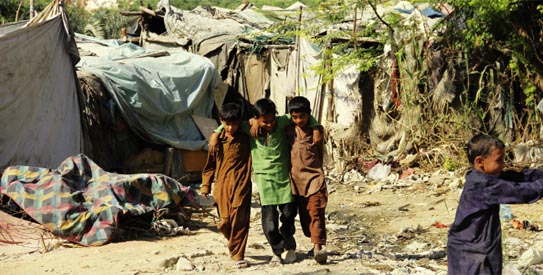
A faltering economy and grinding poverty have challenged people’s resilience; steadily increasing inflation has added to the numbers of people living below the poverty line; currently 27.4 per cent are in that category.
It is hard to say who suffers more, men, women or children. All are equally affected, although the impact of poor health and restricted living appears to be greater on women and children.
The health scene is equally worrisome: Pakistan already has the highest overall population growth rate in South Asia and contraceptive prevalence rate remains stuck at 30 per cent. Family planning facilities are unable to reach out, even now, to women and couples living in far-flung localities. The outcome is: 260 women die of 100,000 live births.
Almost 900,000 abortions take place each year, largely performed under unhygienic and unsafe conditions; they’re sought by married women who already have an average of four or five children because they lack recourse to contraception. Balochistan is most alarming, where 785 women in every 100,000 die in childbirth.
The female labour force is still dismally low, at 23.5 per cent—much lower even than Afghanistan’s at 33.1 per cent; the reason is only too clear—most Pakistanis frown on working women, and the majority of organisations follow suit, with no provision of facilities tailored specifically to women’s needs at the workplace.
Children below the age of five are especially vulnerable to diseases: they die in high proportion, at 87 deaths out of every 1,000—and this ‘improved’ rate too has been achieved after years of effort. Regrettably, these rates are below the regional average.
A silver lining: a modicum of cheer had spread among progressive sectors of society when more women were elected to parliament, and efforts were afoot to improve women’s gender status. Unfortunately, this has not been an easy task: the impact of culture and tradition is well-nigh overwhelming, as is changing the mindsets.
Gender inequality is visible in the low importance accorded to female education, labour rights, health care and equality. The relevant index at 0.573, is a composite of the above. That and the Human Development Index at 0.572 remain below the regional average.
Our own national statistics, as revealed in last year’s National Nutritional Survey show that fully 58 per cent households—more than half the nation—is food insecure; those who were food insecure with moderate or severe hunger were 19.8 per cent and 9.8 per cent, respectively.
Among the provinces Sindh is the worst: a shocking 72 per cent of households here are food insecure. Of these, 16.8 per cent of households are subject to severe hunger, unable to get regularly even one meal a day. Long term malnutrition has resulted in stunting of 43 per cent of Pakistanis; Sindh again is the worst off, with 70 per cent stunting.
Not a pretty picture: long-term neglect of the social sector has led to severe depletion of what could have been Pakistan’s richest resource—its human capital. Those who work in the development sector have seen the inevitability of this sad downward trend, but the powers-that-be seem to remain strangely disassociated from it.
Today, we’re faced with a terrible outcome. The downward regression began some years ago when Ziaul Haq introduced certain laws and policies, ostensibly under Sharia laws.
From that point it was only a step further to restrict women, in mobility, education, availability of health care, freedom to work or to marry according to their own wishes. Certainly these features were present in tribal societies, but that culture and tradition have now penetrated urban centres.
The situation for non-Muslim Pakistanis is no better. Add to that a failing economy and poverty, liberal thinking, with a strong accent on human rights has little room for growth in this atmosphere. There are many who say that Pakistan is close to implosion; whether it implodes because of the political crises that are perennially brewing or because of the impending crisis in the social sector is a moot point. Even now, it is not too late. Pakistan can still, with sincere effort, capitalise on its rich human resource of talented, resilient and hardworking people.




























