0
0

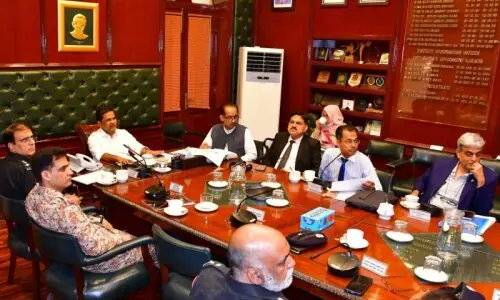
HYDERABAD, Dec 18: Representatives of farmers and managing director of the Sindh Irrigation and Drainage Authority have rejected a proposal to privatise irrigation water and operation of canals made by an expert at a meeting of the Friends of Democratic Pakistan (FoDP) in Islamabad last week.
Farmers' representatives Zahid Bhurgari and Umer Farooq said they had called for strengthening existing participatory-based irrigation system through Sida and disagreed with the proposal, which was part of a report prepared by the Water Task Force of FoDP.
Mr Bhurgari, a member of the Nara Canal Area Water Board set up by Sida, said the FoDP consultant, John Briscoe, who is an expert on environmental engineering, tried to make the point in his presentation that regulation of canal water should be done by contractors or operators to ensure efficient use of irrigation water.
“But we didn't agree with him and proposed that landowner should be charged for getting irrigation water and the money thus collected should directly go to national kitty through the National Bank of Pakistan,” he said.
He said that Mr Briscoe was of the view that landowners did not give much importance to efficient use of water because they did not pay for it while the same farmer would not run a tube-well beyond required time because he paid for its power and fuel.
“So the focus was on this line that water should be made a saleable commodity and independent operators should sell it to farmers, but we said the existing system should be revamped and strengthened because it is already working under participatory-based irrigation system of Sida,” he said.
The FoDP's Water Task Force has prepared a report on water sector, which also includes a proposal for considering Kalabagh Dam but it has been opposed by the Sindh government.
The Sindh irrigation secretary has formed a committee to review the report and compose a reply on it.
Talking to the Dawn, Umer Farooq, chairman of the Farmers Organisations, said that contractor-based system would not be beneficial and existing system should be made more effective.
He expressed dissatisfaction with the working of Sida which was supposed to adopt a participatory-based approach to irrigation system. “We informed the foreign consultant that sowing based system of water distribution may be introduced,” he said.
Sindh needed water earlier than Punjab for wheat sowing so it should be supplied water first and when Punjab was in need it should be given water from the Sindh's share under a properly worked out system, he said.
“We were told there is no political ownership for big dams and that's why a dispute exists between technical and political experts although Pakistan doesn't have capacity to store water for not more than 30 to 40 days,” he said.
Mr Bhurgari emphasised the need for pre and post-flood management in Sindh. “We continue to lose 19,000 cusec of rainwater for around a month through the Left Bank Outfall Drain that can be utilised through a small reservoir somewhere in Thar,” he said.
Sida managing director Ehsan Leghari said that he personally agreed to the proposal for a pilot project for canal operation under supervision of a private contractor. “But this is not government of Sindh's view. It is my personal opinion,” he said.
He said that funds were either not properly released or not efficiently utilised.
Dr Bukshal Lashari, professor of agriculture productivity and water management at the Mehran University of Engineering and Technology, who was also participated in the meeting said there was consensus that farm water management programme needed to be strengthened.