0
0

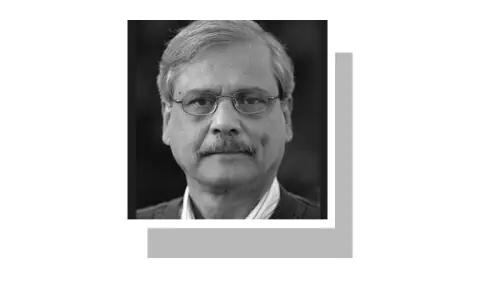
MASOOD Mufti’s newly published book, Chehray Aur Mohray, has been presented as an account of the fall of East Pakistan.
The book consists of two parts — Chehray and Mohray. The first part is an eyewitness account of what happened during the last days of East Pakistan. The eyewitness, Masood Mufti, is well-known as a short story writer and has written a number of stories on the same theme. He worked in Pakistan’s civil service and in that capacity was posted in Dhaka.
But those were ominous times. The political situation deteriorated rapidly and soon Mufti found himself in the midst of a great national tragedy resulting in the disintegration of the country. What he saw and experienced affected him deeply and he felt compelled to record what he had witnessed. The outcome was a superb literary piece of writing, titled Chehray, which may also be read as a piece of reportage. This piece of writing forms the first part of the volume under review.
The other part, Mohray, should be read as a continuation of the first part, though it has been written in a different mood. In fact, Mufti wrote this piece after he was able to gain access to the Hamoodur Rahman Commission report. None of the successive governments deemed it fit to release the report for viewing by the Pakistani people. But it so happened that in 2000 it was leaked to the Indian media and news-papers started publishing it in pieces. Mufti’s doubts were confirmed by the conclusions in the report and so he chose to translate some portions from it into Urdu and accommodate them in this book.
Through this he has raised a number of questions about the way in which the battle was fought. This part of the book discusses openly what Chehray hinted at.
In the first part of the book, Mufti is genuinely engaged in trying to capture the feeling of despondency he and his companions found themselves in. The group of civil officers, herded into a hotel, in a constant state of waiting, not knowing whether they will meet their end at the hands of Mukti Bahini or whether they will be taken as prisoners of war by the Indian army, is vividly captured by Mufti.
The InterContinental Hotel, where the officers were housed, enjoyed the status of being a Neutral Zone. There is a feeling of being desolate and distraught with a sense of impending death. Their situation reminds me of Arthur Koestler’s book, Dialogue with Death. Koestler was among those European writers who, during the Spanish Civil War, had sided with those who were fighting against fascist forces. In the narrative, there comes a time when this group of fighters is surrounded from all sides with no way to escape. Death appears inevitable. It was during those fateful days that Koestler recorded the terrible experience of death slowly stalking a few desolate souls, waiting for the inevitable. Mufti’s depiction is a close reading of the faces of those trapped in the hotel and their tumult.
Chehray Aur Mohray is a sad story of a group of stranded Pakistanis; some trying to save themselves by flattering the winners, but badly failing in their attempt. Others, finding no way out, being at the mercy of circumstances. The writer too is part of this group and his fate is linked with that of his compatriots. But he chooses to remain calm and record the events.
This indeed is a rare piece of writing that depicts the painful story of those fateful days. Masood Mufti has ably captured those crucial moments commonly known as the ‘fall of Dhaka’.