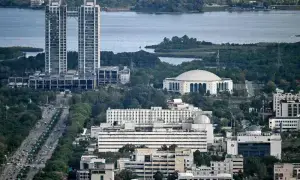
WALKING around the ‘Sindh Museum’ at Hyderabad, established for the basic objective of colleting, conserving, maintaining and displaying Sindh’s fabulously rich record of culture and antiquities was an amusement and pleasure.
The Museum is located at a delightful locale of Hyderabad, the second largest city of the province, which was founded in 1768 by Mian Ghulam Shah Kalhoro, the famous ruler of the Kalhora dynasty, along the bank of the River Indus upon the ruins of Neroon Kot.
The Indus Valley Civilisation, known as Moenjodaro, is on the list of world heritage being one of the oldest civilisations of the world. The Museum provides an insight into the Sindhi culture and traditions depicting the village life, as well as the ancient lifestyle. It also includes earliest artifacts excavated from the site of Moenjodaro. It also allows visitors to get a glimpse of the village lifestyle and inside of a Sindhi home: in the past and the present.
The Museum, bedsides maintaining models and artifacts of Sindh, related to the ancient, mediaeval and modern periods, has established a gallery where contribution and works of some eminent personalities have been displayed. However, what intrigued me was that the most celebrated individuals, who played a pivotal role in the development of art, culture, education and advancement of Sindhi society, and without whose inclusion history of Sindh would look barren, are unfortunately missing.
Some of the missing names, especially from the modern era, who are not only highly praised nationwide for their efforts and contribution they made in their fields but are also ranked outstanding and commended equally at international level. Those omitted are: Mirza Qaleech Baig, Bheroomal Mahar Chand Advani, Hotchand Gurbakshari, Allam I.I. Kazi, Shaikh Abdul Majeed Sindhi, Allama Umer b. Muhammad Daoud Poto, Ghulam Murtaza Shah (G.M. Syed), Hyder Bux Jatoi, Pir Hasamuddin Shah Rashdi, Shaikh Mubarak Ayaz (Shaikh Ayaz), Dr Nabi Bux Baloch, Allama Ali Khan Abro et al.
I hope the Museum authorities would take notice of these omissions and move sooner than later to display Sindh’s most eminent personalities in the gallery in a chronological order.
There is no denying the fact that without adding these names, the ‘Sindh Museum’ would remain deficient, which, in turn, would deprive the present generation and the posterity as well of the knowledge about their efforts and sacrifices made for the cause of advancement of Sindh and its people.
ALTAMASH M. KURESHI Karachi