11
11

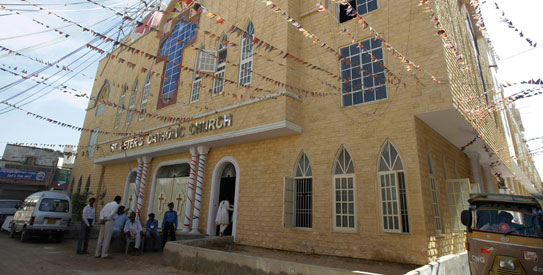
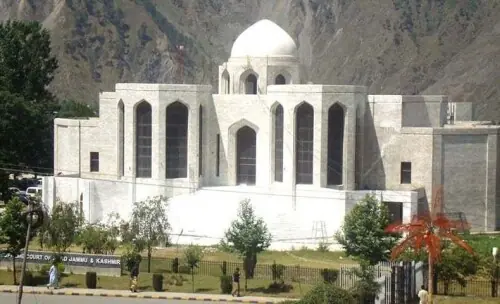
KARACHI: Pakistan's tiny and downtrodden Christian community thought big when constructing its latest church — a domed, three-story building that towers over the sprawling slum it serves and is the largest yet in the violent, Muslim country.
St. Peter's of Karachi, which opened its doors this month and can fit around 5,000 people, is a sign of the resilience of a faith that has long suffered from state discrimination and attacks by extremists allied with al Qaeda and the Taliban.
The church took 11 months to build and cost $3.8 million, raised from local donations and from Roman Catholics around the world, said Father Saleh Diego. It was built on the site of a smaller church in Azam Basti district, a jumble of lanes and simple brick houses that is home to around 15,000 Christians.
"There were so many people here it was not possible for us to accommodate them on Sundays. Some were sitting at the back, some in the corner, some on the terrace," said Diego. "Now we can pray together, all 5,000 people, worship the Lord and really share and strengthen our faith."
Pakistani towns and cities are dotted with striking churches dating back to the 19th century, when the subcontinent was ruled by Britain. Newer churches do get built, especially by Protestant and evangelical groups, but are smaller, single-room affairs.
In some predominantly Muslim countries, such as Egypt and Indonesia, the construction of new churches can trigger tensions and even violence, but those built in Pakistan normally sit in poor Christian neighborhoods like Azam Basti, so they rarely spark protests.
Those few that are built in Muslim or commercial areas can expect some problems, said a Western missionary whose church is about to begin construction of a school and church complex in Punjab province.
"We had some opposition at the start," said the man, who has lived legally and openly on a missionary visa in Pakistan for many years, but declined to give his name for security reasons. "If we put up a big cross, and we called it a seminary, then we would expect that the locals would give us some problems. We will do it slowly."
Christians are often discriminated against in Muslim countries, but in Pakistan they face unique problems.
Most are the descendants of low-caste Hindus, who converted to Christianity when the region was under British colonial rule. Today, many still do the same work as their ancestors: street sweeping, domestic service or other menial jobs.
They tend to live in ghettos of extreme poverty, often separated from their Muslim neighbors by high walls.
In Pakistan, Christians account for between 3 per cent and 5 per cent of the country's 180 million people, split approximately equally between Roman Catholics and Protestants. There are even smaller numbers of Hindus, Sikhs and Buddhists.
St. Peter's is roughly the same size as Karachi's imposing British-era cathedral, St. Patrick's. But it can accommodate many more worshippers because they sit on the floor, not on benches as is common in churches visited by wealthier Pakistanis like St. Patrick's.
The church is a simple rectangular building, adorned with arches and dozens of Gothic spires. Dozens of stained-glass windows depict the sufferings of Jesus Christ, while the walls inside are painted shiny white with large frescos.
On a recent evening, many hundreds flocked to the church, where several young girls were being confirmed.
Dressed in their best clothes, the worshippers took off their shoes — which, like sitting on the floor, is an Islamic custom adopted by some churches here — before walking inside. They sang hymns to the accompaniment of a piano and a 'dhol', a traditional drum.
Outside, conversation turned to the predicament facing the community.
When Pakistan achieved independence in 1947, the country's leaders envisaged a liberal Muslim state that protected minority rights, even if the constitution has always prevented Christians from becoming prime minister or president. But Islamist groups have steadily gained ground, pushing through laws that have marginalised minorities.
"We are called sweepers, and Muslims do not like to share their meals with us," said 18-year-old Joseph Messieh, one of the worshippers at St. Peter's. "It is disgusting."
Sharoon Gill, another young man, disagreed, saying this was unfair.
"Most of my friends are Muslims and we dine out. I never feel discriminated against," he said.
Father Diego said the church was concerned about rising radicalism, but that his building had received no threats.
"Without persecution there is no Christianity," he said. "So we are faithful in persecution and we are faithful to the suffering."