0
0

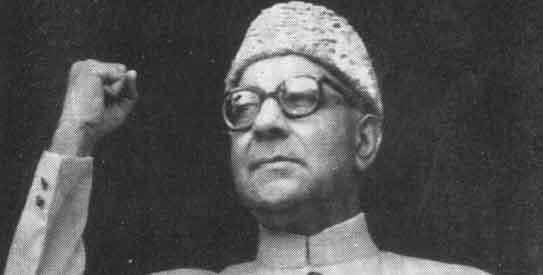
Today is the 60th death anniversary of Shaheed-i-Millat Liaquat Ali Khan
In evaluating the life and work, the achievements and failures of a politician, a statesman or a public leader, one inevitably takes into account what his contemporaries thought of him and his work. Tribute, especially paid on one’s death, provides some clues and insights into hypothesising one’s place in history.
For sure, offering tribute is a bit more than a conventional affair since it focuses on one’s qualities and achievements and relevance to the time one lived in. Liaquat Ali Khan was among those few leaders who had carved for himself a place in history. He had claimed attention both during his brief stint as Pakistan’s first prime minister and in his death. No wonder, his assassination provoked a host of comments from across the world.
Today, on his 60th death anniversary, it is worth recalling some of these, if only to get an idea of how world leaders and the press looked at him.
President Truman, who had paid, perhaps, the most eloquent tribute on Jinnah’s death in 1948, said, “Pakistan, which under the Prime Minister’s wise leadership has met and overcome so many obstacles in taking its place in the world family of nations, has suffered a grievous blow… [But] I know the people of Pakistan, whose qualities have been so clearly reflected in the progress of [the] country, will carry on with calm steadfastness and wisdom.”
While Trygve Lie, the UN Secretary-General, called Liaquat’s exit as “a great loss to the UN”, the British Ambassador to the US, Sir Oliver Franks, said: “Pakistan has lost a great leader whose untiring efforts have brought Pakistan to its present high place among the nations of the world. His loss will be felt far beyond the borders of Pakistan itself, throughout the rest of the Commonwealth, throughout Islam, and indeed throughout the world.”
Liaquat had opted for a pro-West stance in the Korean war, and his death came at the height of the cold war. Hence most American press comments were laced with ideological overtones. In this, the Christian Science Monitor set the tone. It wrote: “The assassination of Premier Liaquat Ali Khan is a blow to Pakistan, to Islam, and the West. For his own country it means the loss of its leading statesman, a moderating influence in a region where religious and nationalistic passions run high, an able spokesman for his nation’s cause.
“For Islam, it means another victory for the extremist fanaticism which would betray the best in Muslim tradition and which threatens to set the whole Muslim world in self-destructive flames. For the West, it removes one of the Asian leaders who best understood the western position… and the necessity for the co-operation of the free world both within and without the United Nations.”
Herald Tribune sought to assess Liaquat’s death on Indo-Pakistan relations, saying: “The assassination… deprives the world of one of its foremost statesmen and may cost it its chances of peace in the India-Pakistan subcontinent… He helped guide Pakistan to nationhood, and as its first Premier, he successfully held in check the extremists… [R]egrettable that the US should have lost so important a friend in world councils.”
Interestingly, Kashmir figured quite prominently in several comments. For instance, the San Francisco Chronicle warned, “an explosion to set the world on fire can come from any of several other sources [other than Kremlin]. One of these is the subcontinent of India, where animosities of the most stubborn and baffling kind — animosities whose roots go down through hundreds of years of history — have lately come to a white heat in the quarrel over Kashmir.”
More specific and more sympathetic was the Globe and Mail, Toronto: “The part the Commonwealth nations might have played in mediating this [Kashmir] dispute was evaded… And now with its most able leader dead, the danger of extremists filling the gap is quite as great as it has been in other countries.”
And almost all felt, as did the Los Angeles Times, that “Pakistan could ill afford to lose a leader of the calibre, the gifts and the personality of Liaquat Ali Khan”, because, as Olaf Caroe, a former NWFP Governor, said, “Three years of Liaquat Ali Khan’s leadership carried Pakistan through difficulty and crisis to the achievement of a degree of political stability rare in any democratic country…, of economic prosperity beyond her own rosiest dreams, and of an honoured place in the affairs of nations.”
The Statesman, Calcutta, said, “He guided the fortunes of his country with a certainty which amounted to genius”. The Times of India, Bombay, remarked, “No man played more successfully the role of Cavour to his leader’s Mazzini”.
This was Liaquat; and these some of the assessments of his life and work.
— The writer is an HEC Distinguished National Professor, co-editor of Unesco’s History of Humanity, vol. VI, The Jinnah Anthology (2010) and In Quest of Jinnah (2007). smujahid107@hotmail.com