0
0

JACKSON, Ga.: The US state of Georgia executed convicted murderer Troy Davis on Wednesday in a case that drew international attention because of claims by his advocates that he may have been innocent.
Davis was put to death by lethal injection at 11:08 p.m. EDT/0308 GMT on Thursday at a prison in central Georgia for the murder of a police officer in 1989, prisons spokeswoman Kristen Stancil said. The execution was delayed by more than four hours as the US Supreme Court considered whether to issue a stay.
The case provoked protests and an online petition accumulated nearly a million signatures because of doubts expressed in some quarters over whether he killed police officer Mark MacPhail in 1989.
MacPhail was shot and killed outside a Burger King restaurant in Savannah, Georgia, as he went to the aide of a homeless man who was being beaten. MacPhail's family say Davis is guilty and his son witnessed the execution.
Since Davis's conviction, seven of nine witnesses have changed or recanted their testimony, some have said they were coerced by police to testify against him and some say another man committed the crime.
No physical evidence linked Davis to the killing.
Davis went to his death saying he was innocent, according to journalists who witnessed the execution.
“The incident that night was not my fault. I did not have a gun,” Davis said, according to Rhonda Cook of the Atlanta Journal-Constitution newspaper.
“I did not personally kill your son, father and brother. I am innocent,” Cook quoted Davis as telling members of MacPhail's family who were present in the death chamber.
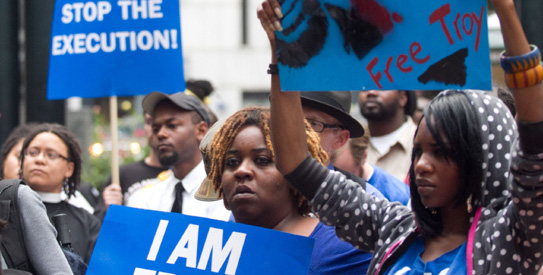
Hundreds of protesters rallied outside Georgia Diagnostic and Classification prison earlier, chanting “I am Troy Davis” and other slogans and a cheer briefly went up when it was reported that the execution had been delayed.
But the crowd dwindled as the evening wore on, and by the time the execution took place they were outnumbered by police in riot gear. Most of Davis' supporters slipped away in silence as the execution was announced.
“This is a tragic moment. We were hoping for a different result,” said Raphael Warnock, pastor of Ebenezer Baptist Church in Atlanta, whose church was once led by slain civil rights leader Martin Luther King.
One sentence order
A majority of Americans support the death penalty and most executions attract little national attention, but the Davis case prompted a rash of protests as well as expressions of concern from Europe.
France and the Council of Europe this week urged US authorities to stay the execution.
Defence attorney Thomas Ruffin put Davis' death in a racial and class context, and pointed out that a disproportionate number of inmates in Georgia's prisons and on death row are black men, as was Davis.
“This night the state of Georgia legally lynched a brave, a good and indeed an innocent man,” Ruffin told a news conference, in a reference to the lynchings of blacks in Georgia and other southern states from after the Civil War through the 1960s.
The Supreme Court took the rare step in 2009 of allowing the defence to present its case to an evidentiary hearing but a federal judge in Savannah said it cast “minimal doubt” on the conviction.
Once a death warrant was signed, Davis's best hope of avoiding execution had rested with the Georgia Board of Pardons and Paroles, but on Tuesday it denied him clemency following a one-day hearing.
On Wednesday, his lawyers went through a series of manoeuverers in an attempt to stay the execution, finally reaching the Supreme Court.
It took the court more than four hours to issue its one-sentence order, an unusually long time in such cases.
Brian Kammer, a lawyer for Davis, said in seeking a stay from the Supreme Court that newly available evidence revealed false, misleading and inaccurate information was presented at the trial, “rendering the convictions and death sentence fundamentally unreliable.”
A handful of supporters of capital punishment in the case also protested separately from Davis' supporters.