0
0

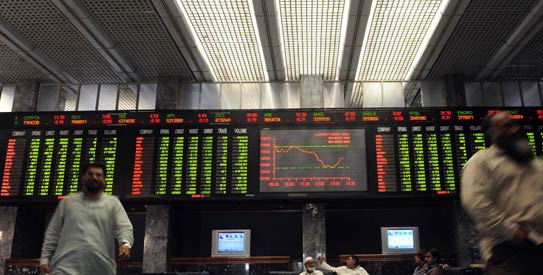
AN unlikely phenomenon, but a few market participants in private conversation argue that regulators are now hostage to stock market.
Top men at the apex regulators’ office in Islamabad and the front line regulator at the Karachi Stock Exchange have been associated with big brokers in the capacity of relatives, friends or former employees.
“Such brokers, therefore, wield power to influence the decision-making process at the regulatory level”, say the accusers.
“Absurd”, said a stock broker. He argued that such a suggestion may have been made by some people, out of jealousy of a couple of financially sound market participants.
But are there any big brokers in the market? A Karachi-based financial daily recently quoted SECP Chairman Muhammad Ali Ghulam Muhammad, as saying: “Previously big brokers could manipulate the market through their own companies. However, the big brokers have not remained big anymore after 2008.”
On query, the SECP chairman told Dawn that what he meant was that stock markets worked with combined efforts of brokers, their agents, clients and other participants. “When all work in harmony, it helps to generate volumes.” Mr Ali also stressed upon creation of awareness, expansion of investor base and depth of the market.
Independent observers concede that for over two decades, the KSE has lived with the unsavory perception of large broker control. “Their number has shrunk fast as some of the big unable to stand competition and after having burnt their fingers in the 2008 crisis, turned their backs on the market and moved into real estate, industry, banking and mutual funds.”
The great market crash of 2008 swept billions of rupees from the market and no one including the stock brokers could escape the damage”, said one analyst. “Saliva drips down the mouth of some people who only see stock brokers as making big money,” said one broker, “but no one realises that stock trading is highly risky business and the field is littered with corpses of brokers who lost every paisa in the market.”
He reminded that as a result of the 2008 crash, two brokers had turned defaulters and as many as eight others were expelled.
“Those brokers were left with nothing except the shirts they wore, after their assets were auctioned by the KSE to pay claims of clients,” he said.
Former chairman KSE, Yasin Lakhani looking back over the years, says that the number of ‘big brokers’——that is to say financially strong members—- may have scaled down to five, from 10, many years ago. He said that cornering of scrips was a thing of the past since larger free floats would frustrate such a move, if made today.
Most market participants agree that as some of the culprit brokers of 2008 crisis fled the country, leaving huge number of unsettled claims, the confidence of small investors in the market was shattered to the core. The volume of trade naturally took a sharp dip.
“No accountability or the identification of perpetrators of the 2008 crisis has been a big blow to investor confidence,” says a former official of the regulatory body, who recalled that the earlier crisis of 2000 was put to investigation that brought out the “Etrat Rizvi Report.” The enquiry into the 2005 crisis was separately conducted by Justice Saleem Akhtar as well as by US forensic investigators.
Regarding investigation into the 2008 crisis, a veteran broker Haji Ghani Haji Usman pondered whether it would serve any purpose to look for skeletons in the cupboard. He also contended that the KSE’s share delivery system of trading plus two days (T+2) had made cornering of scrips difficult, if not outright impossible.
“The seller knows he has to make the delivery within two days, which is quite stringent over the previously prevalent 7-day delivery system, where investors engaged into badla and kept accumulating stocks”, said the broker.
Khalid Mirza who held two regulatory posts of chairman, Competition Commission of Pakistan, and earlier as the head of SECP, unlike others, answered a straight question with a straight answer: “I get the impression that the regulators have been captured by the market.” He named no names.
He said that the regulators ought to be at the same time a monitor, a policeman, a magistrate and a father figure for the market. “It seems that none of those roles are effectively played by regulatory institutions in the country,” said Mirza who also is a visiting professor at the Lahore University of Management Sciences.
The former regulator agreed that the KSE is faced with the one major problem of low volumes and recalled that the capital market was once the most liquid market in Asia. The end of ‘badla’ system of leverage financing, he believed, was a big contributory factor in suppressing and depressing trading volumes. Most market players and investors had blamed ‘badla’ following the 2008 crisis and the universal market cry then were “ban the badla.”
Khalid Mirza pointed out that the replaced product Margin Trading System had not helped bring liquidity into the market. He agreed that the ‘badla’ system had its flaws and needed to be fine tuned, but he argued that discarding the long prevailing, indigenous leverage product of ‘badla’ only because of some of its faults, was like throwing the baby out with the bathwater.