2
2

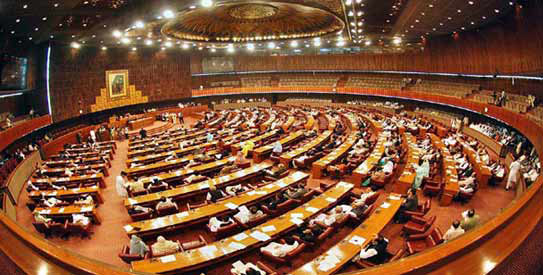
Millions of rupees have been spent on convening a couple of days sessions by the two houses of parliament to discuss the ever-worsening law and order situation with particular reference to Karachi, non-implementation of the Supreme Court orders, and recently held AJK elections which the opposition parties said were rigged. The two houses met last Thursday and Friday, but without any meaningful outcome.
Employees of the Senate and National Assembly get 100 per cent overtime whenever the two houses are in session, apart from Rs300 daily as diet allowance for each of them. Unable to give the exact figure, according to an employee of Senate the amount which will be dispersed under the head of “session allowance” runs into millions. He added that in case of two-day session, “we will get session allowance for 17 days; seven days each prior to calling of the session and after the house is prorogued.” Moreover, the cost also includes provision of air tickets to parliamentarians coming from outer stations to attend the session.But the issue is not of spending public funds on holding parliamentary sessions. All over the world, parliament houses meet their expenditures from national exchequer and lawmakers receive monthly salaries along with session allowance.
The question is if our parliamentarians are aware of this cost, which they need to return in the form of improved governance. One may ask what was the outcome of the two houses' sessions on important national issues?
The PML-N and MQM legislators were signatories to requisite sessions of the National Assembly and Senate. Sitting together on the opposition benches, it was expected that the PML-N and MQM would give treasury benches tough time and push the government to take some concrete steps, addressing the issue of Karachi killings and non-implementation of the apex court orders.
But just before the sessions of the two houses on July 21, the MQM staged yet another volte-face. Ishratul Ebad came back to Karachi and took over the charge of his gubernatorial duties in Sindh on July 19. It meant rapprochement between the ruling PPP and the MQM, leaving the PML-N alone to attack the government.
In the absence of orator Chaudhry Nisar Ali Khan, leader of the opposition in the National Assembly, the responsibility of starting debate fell on Khawaja Asif, veteran politician from Sialkot, who turned out to be a total disappointment.
Ill-prepared and lacking direction, his speech entirely focused on the marriage of convenience between the ruling PPP and PML-Q, a coalition that looks to have, at least for the time being, outplayed the PML-N.
Throughout his speech Mr Asif conjectured how Asif Ali Zardari and Chaudhry Shujaat Hussain have come closer to save each other. Then he discussed the much-talked about National Insurance Company Limited (NICL) case, involving son of senior minister, Chaudhry Pervez Elahi, and the government's attempts to save him.
He did speak on violence in Karachi and AJK elections which the PML-N says was rigged – the two issues mentioned in the application to requisite the session. However, his arguments lacked concrete suggestions how his party wanted to resolve this situation.
MQM's Haider Abbas Rizvi pointed figures at the PPP for inciting violence in Karachi. Due to his party's rejoining hands with the government in Sindh, his argument wasn't taken seriously.
PML-Q's Sardar Bahadur Khan Sihar, who has recently been appointed state minister for defence production, defended his party's alliance with the PPP in the centre and castigated the Sharif brothers.
On the second day government lawmakers, led by Prime Minister Yousuf Raza Gilani, came up with tailor-made speeches, pledging measures to control target killings in Karachi and that nobody would be allowed to disrupt peace of the country's economic hub. But nobody wound up the discussion.
At least formation of an all parties committee to investigate target killings in Karachi would have saved the day for the opposition. Alas, there is no end to killings in Karachi. The confrontation between the executive and judiciary is touching new highs. And despite serious rigging allegations, the AJK assembly has elected its prime minister and formed the government.