4
4


It’s quite remarkable that just one area alone (let’s say within a radius of 500 yards) can be known, and famous, for multiple reasons. The biryani that you can feast your eyes on here is to-die-for. The mixed chaat available on the pavement across the biryani wallah, though only after dusk, is lip-smacking delicious.
Then there is this paper market which caters to all kinds of printing needs, therefore those with smalltime or big printing presses find this zone appropriate to buy business material from. The shops making and selling wedding cards are no less recognised. And most of all the colonial buildings that stand quietly (if somewhat painstakingly) amidst the modern-day socio-architectural haphazardness are a treat to look at.
Specifically, this is one end of Haqqani Chowk that touches Pakistan Chowk through Outram Road.
Going past the awe-inspiring D J Science College, you’ll discover that the first street to the left of the roundabout is a world unto itself. Not just on either side of this narrow road but the lanes that branch out from this constricted street too boast of a host of gorgeous structures. Try and ignore the irresistible aroma of biryani wafting through the air from the shop on your right and… keep moving. Despite the mushrooming of many new concrete giants, the one-hundred-years-old (or more than that) buildings will attract your attention in no time. To begin with, there’s Kamil Mansion. It is difficult to believe if that’s its maiden name. It’s reasonably big in size with stones featuring prominently in its making. The eateries and a few other shops on its ground floor obscure its identity to a certain extent, but walking into the galli to have its side-view will give you a fair idea about the mansion’s age and charm.

Once in the galli, it’s impossible not to explore it. The year 1934 is clearly marked on another work of stonemasonry, which has smaller dimensions primarily because of the fact that it is sandwiched between two concrete ‘modern’ buildings. The locals call it Hanif Building. Its first name, if there ever was one, couldn’t be ascertained. This is not the case with Shamdas Building facing Hanif Building. A couple of more pieces representing colonial rule the covering grilles on whose balconies carry engraved Hindu names (such as Mancharam Thadani) further speak of the time period when architecture was treated as an art form.
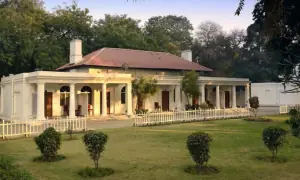
Now return to where the journey began from, a food street of sorts, since it’d be a mistake missing out on a beautiful, spacious compound next to a mosque. It’s a breathtaking edifice which was not too long ago popular as Railway Restaurant. Today it has morphed into a mini market dotted with all kinds of shops. The plaque on its entrance reads Mengharaj Dwarkadas Nespal Building. According to a shopkeeper, during the British Raj this facility was used as a restaurant and was frequented by those who’d travel by train as well as by the city dwellers. Stepping into the compound will point to other facets of contemporary ‘living’ (a clinic, a paper shop etc) and residences on the upper floor. Never mind how it’s being used, for no one can help it.
It’s the unusual architectural characteristics of Railway Restaurant that first and foremost instill in you the yearning for its restoration. The embellished big balconies and outer walls are a sight to behold. The decorative elements are still very much intact. In the middle, over the entrance, the size of the openings widens and the balconies become larger, giving it a royal touch. This beauty is one of its kind. If the authorities concerned can refurbish it a little, Railway Restaurant will look just as scrumptious as the biryani tastefully served in a hotel in the same neighbourhood.
The mosque in the same row is called Dakkani Masjid. It doesn’t seem to be a pre-partition place of worship. However, a shopkeeper suggests it was originally stone-made which later on, some years after independence, gave way to a newer look.
Hop across one more time, parallel to where Kamal Mansion is located, and you’ll see a series of nice-looking stone structures.
None is better and bigger than Shivaji Asalji Building, now Rukhsana Building. Again, it’s a marvelous example of architectural acumen primarily because of its size. Having said this, the simplicity of design is not to be overlooked either. The windows are a special attribute of Rukhsana Building. Some have been painted white without compromising on the shape to have a contemporary ‘feel’, while others give off a palpable colonial vibe and are not well maintained.
Naqi Mansion and Zainab Manzil belong to the same group, with Zainab Manzil having fewer pilasters and is difficult to fit into one category. This is exactly that part of Haqqani Chowk where Paper Market, or some part of it, is situated.
Architect Arif Hasan says, “The Hindu community used to live here, the affluent ones. I think these buildings were built in the 1920s or slightly earlier. Some of them are lime & mortar pieces which have arches on the lower floor, square windows on the upper with trellises etc. There are stone buildings with elements of Indian Ocean port architecture; so one particular style can’t be identified. As for Railway Restaurant, there was a time when it was a very well-known place. It’s a lovely old building.
These days, as you may have seen, this area comprises paper stores and other businesses. Families also reside in them. “Now the change that has come about in this area owes largely to degradation and land use. What can be done is to organise the activities that take place here. For example, with respect to traffic, there’s a need for ‘zoning’. This means traffic needs to be managed with better parking facilities. The bylaws must be conservation-related that will have to be followed. Three things – texture, scale and public space – should be maintained so that the locality could be reorganised. It is doable and requires an institution which carries out the necessary research,” says Arif Hasan.
Dusk has settled. The sun is all but disappeared into the Arabian Sea. The craving for mixed chaat!