0
0

HYDERABAD, Oct 31: Only 2.6 per cent of the 18 million Pakistani youth between the ages of 17 and 23 years is enrolled in institutions of higher education.
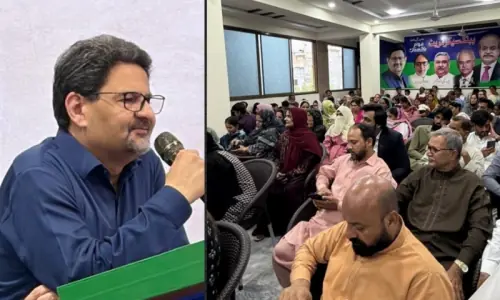
This was stated by the vice chancellor of the University of Sindh, Mazharul Haq Siddiqui, while speaking at the lecture on ‘Higher Education Reforms in Universities.’
The series of lectures on organisational development has been organised by the Sindh University’s department of public management sciences University of Sindh in connection with series of Lecture, on Organisational Development here on Friday.
Siddiqui, who is also the member of the steering committee on higher education, said that of the total student population, 82 per cent were enrolled in colleges and 18 per cent of them were are enrolled in the universities.
Giving details regarding other countries, he said 79.7 per cent of the total student population was enrolled in universities in the United States, 54.8 per cent in South Korea, 13.9 per cent in Saudi Arabia, 6.2 per cent in India 6.2, and 10.2 per cent in Indonesia.
Defending the education reforms envisioned under the Model University Ordinance, the Sindh University vice chancellor said that most of the reforms were not new, adding that the recommendations mainly focus on higher education in the universities.
He said that the reforms would pave way for greater freedom to the teachers besides providing excellent support to the meritorious poor students.
Highlighting previous efforts to improve higher education, he said that new education policies were outlined after Pakistan Education Conference in 1947 besides setting up the commission on national education in 1959.
He said that new education policies were announced in 1972, 1979, 1992 and 1998, adding that higher education reforms were announced in 2001-2002.
He said that the task force entrusted to prepare the report comprised eight public sector universities’ vice chancellors, four government functionaries and officials of six private sector universities.
Referring to the consultations held before submission of ht task force’s report, he said that seminars were held, which were attended by prominent educationists, representatives of the private and public sectors, NGO’s, students as well as faculty members.
Siddiqui said that there was a minor misunderstanding about public-private partnership, adding that the recommendations did not mean privatisation of the universities but a broader support from the private sector for improved productivity.