0
0

KARACHI, July 9: The Federal Board of Revenue (FBR) is embarked upon a policy to encourage organised sector of the economy by facilitating compliant people over non-compliant persons through different rates of taxes and duties.
There is a greater need to get rid of exemptions, particularly when around 60 per cent of the economy was presently getting such facilities in one way or the other and creating distortions and corruption in the taxation system.
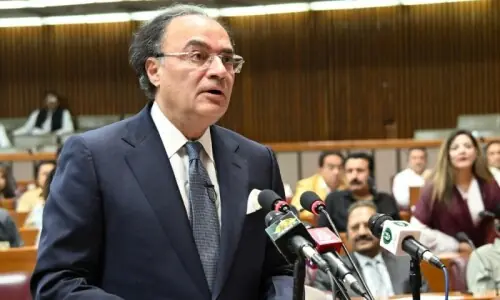
This was stated by the chairman of FBR Salman Sidduqi here on Saturday during a meeting with stakeholders in the offices of Sindh Board of Investment (SBI) at the FTC building.
The meeting was primarily called for discussing different issues and anomalies arising out of budget. Initially strong resistance was witnessed from stakeholders over a number of taxation measures but finally a broader consensus was reached.
The FBR chairman, however, on the occasion announced that a fine tuning will have to be made to the suggestions and proposals coming out of the deliberations and for this another meeting will be held on Tuesday, July 12 in Islamabad.
A major source of contention between the FBR and the stakeholders was the sales tax on import of capital goods.
Zubair Motiwala, advisor to Sindh chief minister, headed the private sector where most of the leading industrialists, including Bashir Ali Mohammad, Jawed Bilwani, Rafiq Godial, Khawaja Usman were present.
The FBR chairman was assisted by Iftikhar Qutub, Khawaja Tanveer, Raza Bakir, Dr Jawwad Agha and tax consultant Shabar Zaidi. However, it was generally felt by the participants of the meeting that there was greater need to encourage documentation of economy.
Consequently, the imposition of 16 per cent sales tax on import of capital goods (plant and machinery), the chairman FBR said was to keep a track over industrial activity and bring it under documentation from day one.
However, it was pointed out that capital goods imported by registered industrial establishments could always be traced out and the problem is only for those goods (plant and machinery) which are imported by commercial importers.
It was pointed out that most of the machinery imported by commercial importers lands in the hands of unregistered or unorganised sector; therefore, a mechanism should be devised so that such imports (plant and machinery) also find its way to compliant and bonafide registered people.
It was also pointed out that both industrial and commercial importers are registered but after the arrival of plant and machinery imported by the latter, it could not be known where it had been sold.
In order to resolve this issue it was suggested that the FBR should seek any banking instrument from commercial importer which could be encashable in case such capital goods are sold to non-registered persons. And in case of industrial importer of plant and machinery it was recommend that a post-dated cheque be sought by customs which should be returned on first filing of sales tax return.
There was a consensus that these measures would help encourage people to move into organised sector of economy and register themselves with the sales tax and start contributing towards national economy.
The stakeholders also raised anomalies pertaining to dyes and chemicals which are still being charged at higher tax rate of 3.5 per cent whereas other input tax rates have been reduced to 1 per cent.
The issue of caustic soda was also raised by the stakeholder and was pointed out that FBR agreed that all raw material used by more than 70 per cent by the textile industry would be subject to zero rating. It was pointed out that higher tax rate was encouraging ‘flying invoice’ culture and would result in revenue loss.
However, caustic soda is one of the major raw material used by the industry but the budget did not remove it from the sales tax. However, the FBR chairman and his team was having different views on the issue and it was finally stated that is should be taken up again in the next meeting.
Problems pertaining to DTRE and other anomalies were also raised and the FBR chairman was particular in stating that issue of suppression and variation in production also needed to be resolved from revenue point of view.