



 16
16

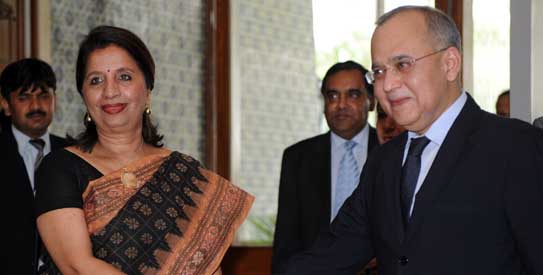
The India - Pakistan foreign secretary level meeting concluded on a happy and congenial note. Once again many promises were made, new directions chartered and pledges to make the process conclusive and positive have been reaffirmed. However, given the past record, it leaves the interested Indian-Pakistani audience with a mix message.
There have been many incidents in the past where the people have brought out their proverbial pompoms prematurely and played the cheerleaders, with little to celebrate in the end. Meetings which were initiated at a high note, only to turn sour, such as the Agra summit or Krishna-Qureshi meeting last year.
The statement followed by a press brief as such did not draw any conclusive lines, though an air of congeniality and cooperation was very much evident. One reason could be Nirupama Rao’s appointment as the next Indian envoy to the US, and hence a desire to leave a positive imprint on the process. But let’s not trivialise the process by bringing in personal stakes, as the last thing the process as fragile as ours can afford is an actor and not factor based input.
If we go by the body language of the two interlocutors, then it was a very relaxed, stress fee and a happy one. Interestingly, the media spotlight was not so fully focused on the two perhaps deliberately, perhaps for the reason that there were hosts of other breaking news to make and break, such as the return of the stranded and captured merchant ship’s crew, forthcoming elections in AJK, discovery of a bomb outside a Shia mosque in Karachi etc. or at worst, it was an indifference towards the talks.
The talks concluded over the commitment to continue with the engagement, as put forth by Secretary Salman Bashir, plus there was empathy towards each others’ positions, especially over the sensitivity surrounding the Mumbai incident. On the other side, a muffled but clear hint towards conditionality with regards to the sustainability of the process was visible.
The talks laid out a framework for the resumption of talks beginning next month, plus acknowledgment of the need to settle Kashmir for the larger good of the affected population. However, a sobering reality check is that verdict is already out on the Siachen dispute – and that is a clear and solid no from the Indian military establishment, regarding a withdrawal. According to a WikiLeaks cable from 2006, “strategic advantage over China, internal army corruption, distrust of Pakistan and a desire to keep hold of advantageous territory that thousands of Indian soldiers have died protecting.”
The need to resolve the Siachen glacier issue is even supported strongly within the Indian intelligentsia circles, who acknowledge the futility of continuation of this engagement, which ends up claiming more lives not through enemy gunfire on both sides, as much as owing to the harsh and inhospitable weather. Besides, it also provides both sides with an excellent confidence building and diplomatic marksmanship opportunity both for domestic and external audience.
Alongside the modest advancement made on nuclear CBMs and risk reduction measures, since the initiation of the process, Siachen and Sir Creek issues have been considered to be minor irritants for which the routine statements issued are those of substantial progress being made, in order to placate the interested audiences. However, in reality, it is the distrust of not only the adversary, but internal actors, the fear of losing the heavily guarded and maintained clout of interest groups across the board and the reinforcement of a warped Meta narrative which is extremely important to run this conflict industry. The creators of this Meta narrative have successfully manipulated and tamed media to a larger extent to be the instruments of war mongering, given the amount of monetary investment done by some, however they err in underestimating the outreach and outgrowth of media. When Pakistan made the Kargil blunder, it learnt this lesson very well, from the neighboring channels the mantra of hyper nationalism at times adds to the prevailing suffocation.
However, if both sides honestly aim to not merely engage but enter a happy wedlock for the growth, progress and prosperity of their people, going by the rhetoric of the foreign secretaries, then the first step is to be honest to one’s own self and the need to re-visit history. Luckily for us, our history books only need to retrace sixty four years. We need to re-examine, what exactly is the Kashmir problem, who occupied Siachen first, and what have been the real cost of this occupation for each side, what were the rationale and outcomes of the various wars fought and where did the mapping over the Sir Creek go awry.
If we are successful in this introspection, the next step is to build mutual and internal trust, confidence and a strong peace constituency; the rest will fall in place. Till the mid 1990s, India and Pakistan chartered the same directional paths, however there has been a gradual to abrupt de-hyphenation as brought forth by the US, which has put them on totally different trajectories. The question is not about de-hyphenation alone, the issue is that we are conjoined twins, attempting to move in different directions, but remain bound to each other through our shared unsettled history.
The writer is faculty member at the Defence & Strategic Studies Dept, at Quaid-i-Azam University, Islamabad.

























