0
0

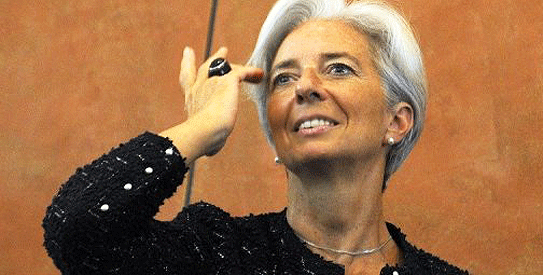
WASHINGTON: French Finance Minister Christine Lagarde is the odds-on favorite to become the next IMF chief as nominations close Friday, with her main rival short of any endorsements from major economies.
With much of the International Monetary Fund's resources now focused on Europe's debt problems, Lagarde was expected to keep the region's lock on the managing director slot, even though many experts said Mexico's central bank governor Agustin Carstens was better-qualified.
Both were still intensely lobbying world leaders for support ahead of the IMF's likely two-week process to choose a new chief from the shortlist.
Lagarde left China Thursday for Lisbon for the African Development Bank's annual gathering. She then will travel to Saudi Arabia and Egypt.
Meanwhile Carstens was expected in India Friday, and would arrive in Washington next week.
But most gave Carstens only a slim chance at beating his European rival, given the depth of the IMF's involvement in Europe's crisis.
“In these circumstances it's difficult to win against Christine Lagarde,” said Brookings Institution economist Colin Bradford.
“Obviously she's a good candidate. Carstens has not been able to gather enough support.”
At least three names are expected in the hat when nominations close late Friday to replace Dominique Strauss-Kahn, who resigned last month to face sexual assault charges in New York: Lagarde, Carstens and dark horse Grigory Marchenko, the head of Kazakhstan's central bank.
Reports on Thursday also suggested that South Africa could propose its planning minister, Trevor Manuel, with the support of many African countries.
Strauss-Kahn's May 14 arrest sparked a brash, concerted move by Europe to push another one of their own to lead the globe's key emergency lender.
That was met with strong calls from emerging economies to break the pact, dating back to the IMF's founding after World War II, guaranteeing Europe the IMF leadership and the Unites States the presidency of the World Bank.
But Carstens, a former IMF deputy managing director, has failed to pull together a coalition of emerging economies, or even secure solid backing Latin America.
And with the IMF board geared to decide the issue on consensus rather than a vote, most importantly, none of the key BRICs emerging powers - Brazil, Russia, India, and China -has endorsed him.
“In private they have already conceded that they are mostly likely to back Lagarde,” said former IMF executive board member Domenico Lombardi.
Emerging economies “see her as an important backstop to the European crisis,” he said.
The IMF's huge commitment to the rescues of Ireland, Portugal and Greece is likely to be a key factor when the 24 IMF board members begin reviewing the candidates next week for an end-June decision.
In recent weeks the Fund has been mired in discussions with the European Union, the European Central Bank and private creditors over preventing the derailing of their 110-billion-euro rescue of Greece, which many economists say was misguided from the beginning.
Carstens and other critics of Lagarde have cited her determined defense of the 17 member eurozone as a risk for the IMF.
“It is clear that for the moment, they (European nations) have not managed to get to a situation where they have full credibility,” Carstens told AFP.
Sebastian Mallaby of the Council on Foreign Relations said Thursday that Carstens could offer “a fresh approach”.
“Lagarde is far less likely to do so, because as France's finance minister she has been part of the team that caused the mess in the first place.” Lagarde has stressed that she does not represent just Europe.
But Europe's efforts to make their choice a fait accompli raised hackles in many corners. While high European officials were calling it a “done deal”, India's IMF director Arvind Virmani blasted the non-transparent nature of the process.
“There are a lot of people who feel that the process has not been credible... that certain countries, certain nationalities were virtually pre-selected,” he told AFP.
Marchenko, who told the Telegraph newspaper that he only learned by text message of his nomination as a possible BRICs compromise candidate, said he understood Lagarde was shoe-in from the beginning.
“It's pretty clear the deal has been reached,” he said.