0
0

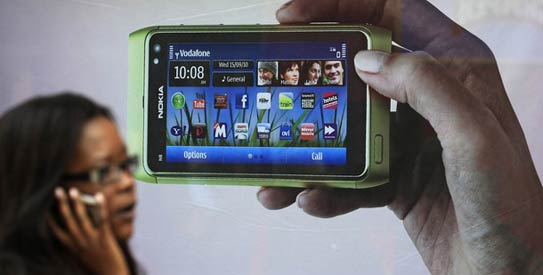
London: A mobile phone may increase the risk of developing certain types of brain tumour and consumers should consider ways of reducing their exposure, World Health Organisation (WHO ) cancer experts said on Tuesday.
A working group of 31 scientists from 14 countries meeting at the WHO’s International Agency for Research on Cancer (IARC) said a review of all the available scientific evidence suggested cell phone use should be classified as “possibly carcinogenic”.
The classification, which puts mobile phone use in the same broad IARC cancer risk category as lead, chloroform and coffee, could spur the United Nations health body to look again at its guidelines on mobile phones, the scientists said.
But more lengthy and detailed research is needed before a more definitive answer on any link can be given.
The WHO had previously said there was no established evidence for a link between cell phone use and cancer.
“After reviewing essentially all the evidence that is relevant... the working group classified radiofrequency electromagnetic fields as possibly carcinogenic to humans,” Jonathan Samet, chair of the IARC group, said in a telebriefing.
He said some evidence suggested a link between an increased risk for glioma, a type of brain cancer, and mobile phone use.
The WHO’s position has been keenly awaited by mobile phone companies and by campaign groups who have raised concerns about whether cell phones might be harmful to health.
Industry groups immediately sought to play down the decision, stressing that the “possibly carcinogenic” category also includes substances such as pickled vegetables and coffee.
“This IARC classification does not mean that cell phones cause cancer,” said John Walls, vice president of public affairs for the United States-based wireless association CTIA.
He noted that the IARC working group did not conduct any new research, but reviewed published studies, and said other regulatory bodies such as the US Food and Drug Administration have stated that “the weight of scientific evidence has not linked cell phones with any health problems”. John Cooke, executive director of the British-based Mobile Operators Association, said IARC had only found the possibility of a hazard. “Whether or not this represents a risk requires further scientific investigation,” he said in a statement.
Previous studies inconclusive
The IARC remarks follow a study published last year which looked at almost 13,000 cell phone users over 10 years and found no clear answer on whether the mobile devices cause brain tumours.
Many previous studies have also failed to establish any clear cancer link, but a US study in February found that using a mobile phone can change brain cell activity.
Use of mobile phones has increased hugely since their introduction in the early- to mid-1980s. About 5 billion mobile phones are currently in use worldwide.
Christopher Wild, IARC’s director, said it was important that more research should be conducted, particularly into long-term and heavy use of mobile phones.
“Pending the availability of such information, it is important to take pragmatic measures to reduce exposure such as hands-free devices or texting,” he said.
Malcolm Sperrin, director of medical physics and clinical engineering at Britain’s Royal Berkshire Hospital, said he thought the IARC move was appropriate because it reflected the “anecdotal evidence that cancers may be associated with phone usage”. But he added:
“It is vitally important to fully understand that there is no definitive correlation”.