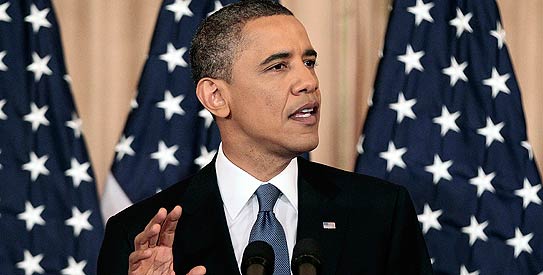
WASHINGTON: The US Congress, racing the clock and rejecting demands for additional safeguards of civil liberties, passed a bill on Thursday to renew three expiring provisions of the anti-terrorism Patriot Act.
President Barack Obama, traveling in Europe, signed it into law shortly before the provisions were set to expire at midnight on Thursday. A White House aide said he used an “auto pen,” which replicates his signature.
Obama acted shortly after the Republican-led House of Representatives and the Democratic-led Senate approved the bill overwhelmingly. It passed the House, 250-153, hours after it cleared the Senate, 72-23.
Democrats and some Republicans favored more protections of civil liberties in the legislation for law-abiding citizens.
But congressional leaders, facing the midnight deadline and possibly short on votes, agreed to a four-year, unaltered extension of the provisions to track suspected terrorists.
The provisions empower law enforcement officials to get court approval to obtain “roving wiretaps” on suspected foreign agents with multiple modes of communications, track noncitizen “lone wolves” suspected of terrorism, and obtain certain business and even library records.
“Although the Patriot Act is not a perfect law, it provides our intelligence and law enforcement communities with crucial tools to keep America safe,” said Senate Majority Leader Harry Reid, a Democrat.
“The raid that killed Osama bin Laden also yielded an enormous amount of new information that has spurred dozens of investigations yielding new leads every day,” Reid said.
“Without the Patriot Act, investigators would not have the tools they need to follow these new leads and disrupt terrorist plots,” Reid said.
The provisions are key parts of the Patriot Act, which was enacted after the Sept. 11, 2001, attacks on the United States.
While backers say the provisions bolster US security, critics say they could be abused and violate the rights of US citizens.
The American Civil Liberties Union, which has long called for changes to the Patriot Act, said Congress missed an opportunity to amend the measure to include privacy protections.
“Congress has once again chosen to rubberstamp the Patriot Act and its overreaching provisions. Since its passage nearly a decade ago, the Patriot Act has been used improperly again and again by law enforcement to invade Americans' privacy and violate their constitutional rights,” ACLU legislative spokeswoman Laura Murphy said in a statement.
'Not Even A Word'
Senate Judiciary Committee Chairman Patrick Leahy, a liberal Democrat, and Republican Senator Rand Paul, a favorite of the conservative Tea Party movement, together offered steps to bolster oversight of the Patriot Act and increase civil-liberty protections.
Their proposed changes cleared the Judiciary Committee, but Leahy and Paul were unable to bring them up for a vote by the full Senate.
Leahy said, “The extension of the Patriot Act provisions does not include a single improvement or reform, and includes not even a word that recognizes the importance of protecting the civil liberties and constitutional privacy rights of Americans.”
But Senate Republican leader Mitch McConnell said, “The invaluable terror-fighting tools under the Patriot Act have kept us safe for nearly a decade, and Americans today should be relieved and reassured to know that these programs will continue.”
The Senate had been tied up in procedural knots over the measure for days. It moved after a push from FBI Director Robert Mueller and National Intelligence chief James Clapper.
In letters to congressional leaders, Mueller and Clapper wrote that renewal of the provisions was vital to national security. Clapper said that if Congress allowed any lapse in the provisions, “Even for the briefest of time, the nation will be less secure.”