0
0

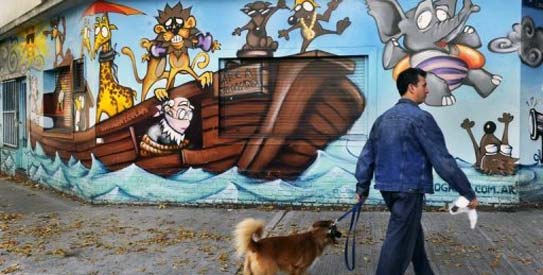
BUENOS AIRES: A portrait of a murdered activist stares from the graffiti on the wall, a slogan makes a passer-by smile, a colorful pastiche turns visitors' heads: welcome to the city where the walls talk.
“Buenos Aires has become a haven for street art, like Sao Paulo and Mexico City,” said Fernando Aita, one of several young editors of the project “Grafiti escritos en la calle” – or “Graffiti street writings.” His website, which encourages fans to “look at the city through different eyes,” has compiled 1,000 photographs of graffiti art dating back to 2009 in a remarkable visual and linguistic archive of modern times in Argentina.
“Plants do not bite,” “A present for our future” and “The fight continues” are among the phrases that stop passers-by in their tracks, amid a flourishing collection of colorful frescoes.
“It's difficult to speak of graffiti as the city's heritage because they are ephemeral, but it's true that street art is part of Buenos Aires,” said Luis Grossman, who heads the city's historical center.
He supports the blossoming of graffiti which he says “embellishes the city.”But the scribblings are also a menace. The Cabildo colonial building, where an uprising on May 25, 1810, sparked a revolution, is constantly tagged.
Authorities have spent huge sums repainting it, in vain.
Graffiti Mundo, a local firm, is tapping into a touristic goldmine by organizing guided tours of the city's best frescoes.
Even tragedy finds a place among the writings on the wall.
“No more Cro-Magnon,” wrote the parents of victims who perished in a fire at the club of the same name in December 2004 that left 194 people dead.
Another graffiti reads “Caution: they are armed and at large,” a reference to alleged police brutality, complete with a stencil of a policeman's cap next to the warning.
These walls can speak, providing a detailed account of how Argentine society has evolved over the past 10 years.
“In 2002, in the middle of Argentina's economic crisis, the graffiti was even more political,” said Lelia Gandara, an expert in the study of signs and symbols at the University of Buenos Aires. “People were expressing their anger and outrage.” Aita explained that after those fury-filled times, “more colored frescoes began appearing. And now, hip-hop tags are prevalent.” But political commentary regained a graffiti foothold after the death of former president Nestor Kirchner in October.
He was featured on walls as the character “Nestornauta”, a reference to sci-fi comic El Eternauta, created by comic strip writer Hector Oesterheld, who was kidnapped and killed under the country's 1976-1983 dictatorship with his three daughters.
Mariano Ferreyra, a student killed in 2010 by union activists, is also a popular character in the graphics dotted across the city.
Another popular figure is Julio Lopez, the first person to go missing after democracy was restored in Argentina. He was kidnapped in 2006 after testifying against policemen for crimes committed under the military dictatorship.
Along Defensa Street, one of the oldest in the San Telmo neighborhood home to many antique dealers, a cartoon cow, painted every 30 meters, asks: “Who is thinking about us?”Scenes of people dancing the tango follow further down the street.
“The streets used to be gloomy. Painting the walls brings a little bit of joy,” said Jaz, a 29-year-old screenwriter who has had a passion for graffiti since he was a teenager.” It's my way of making the city mine.” Jaz acknowledged street painting is illegal, “but the government and the police turn a blind eye as they have more important problems to deal with.” Sometimes even homeowners give in to the trend and order custom frescoes, some more expensive than others, to decorate their walls.
“What a beautiful wall to paint!” read one graffiti on a wall that had just been freshly whitewashed.