0
0

PESHAWAR, May 20: None of the public sector universities in Khyber Pakhtunkhwa has complied with the Higher Education Commission's (HEC) policy guidelines to prevent sexual harassment on the campus, it is learnt.
Being regulator of higher education institutions the HEC had formulated a year ago an elaborate mechanism for dealing with the complaints related to sexual harassment on university promises. However, none of the universities in Khyber Pakhtunkhwa had implemented the mechanism as per policy, according to investigations being carried out by a high-level committee of the provincial government.
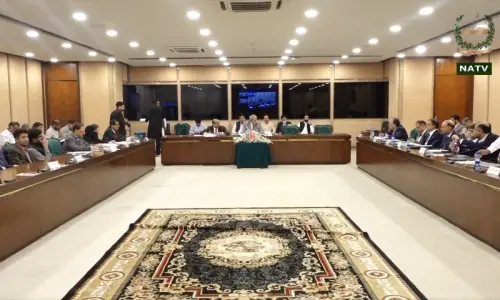
The government had constituted a committee under provincial minister Sitara Ayaz to look into the complaints of sexual harassment at the University of Peshawar (UoP), as raised at the provincial assembly last month.
The committee besides looking into the affairs of the universities was also verifying whether they have put in place effective measures against sexual harassment or not.
A member of the probe committee, wishing anonymity, told Dawn that to the astonishment of the committee none of the public sector universities in Khyber Pakhtunkhwa has followed the HEC policy guidelines.
“The UoP management has no idea that they have the HEC policy guidelines on the issue,” lamented this member, while citing the university management's reply to the committee's queries.
Sitara Ayaz argued that it had been a major failure on the part of university administrations that they did not implement the HEC guidelines and increased the vulnerability of different people to sexual harassment.
“Believe me, if they just implement what the guidelines say there will be hardly a complaint,” claimed Ms Ayaz, when approached by this correspondent for comments.
The probe body has checked with the administration of UoP and other government-run universities about the guidelines, she said and added that unfortunately, none of them had followed them.
“This will be our major recommendation in the report to the government to make sure the universities implement the HEC guidelines,” Ms Ayaz said and hoped that the committee would submit its report by next week to the chief minister for action.
The HEC policy guidelines, compiled through consultation involving all stakeholders, envisaged the appointment of Harassment Monitoring Officers (HMOs) and setting up of a full-time Harassment Complaint Cells (HCCs) to deal with such complaints.
As per the guidelines, the HMO is supposed to be an employee of the university to be appointed by Syndicate, Executive Council or Board of Governors with minimum 10 years of service experience in the same institution and bearing sound reputation.
The HMO will develop tools, educational programmes etc to promote awareness and foster an environment free of sexual harassment in the institution besides carrying out complaint resolution through informal and formal means.
Apart from this, as per the guidelines the HMO will also act as an impartial counsellor and advisor to any member of the university and maintain an unbiased attitude to all complaints.
The university administrations were required to set up an HCC to facilitate policy implementation. Complaints of sexual harassment or any other forms of harassment could be lodged with this cell.
This would require a team consisting of a full-time trained professional HMO, computer specialist and assistant, who could follow up the documentation through relevant offices.
This cell was required to sensitise all university faculty, staff and students to sexual harassment through workshops and trainings. All staff/faculty that enter the university employment would require completing a three-day essential sensitisation training programme as an ongoing activity.
Another member of the probe committee, wishing anonymity, told Dawn that the UoP's step of suspending a teacher of History Department had been taken without following the procedures defined in the HEC guidelines.
Citing the guidelines, this member said that resolution of complaints could be made through counselling at first step. However, if the complainant wishes to follow through the hearing and tribunal procedures, he/she would be required to fill a complaint form that would be available in the cell.
“But it did not happen in this particular case,” the member pointed out.
When contacted, a spokesperson for the Peshawar University insisted that they had complied with what the HEC had advised them. He, however, clarified that setting up of Complaint Cell and appointment of HMO involves financial implications and thus requires approval of different forums.
“Compliance with the HEC guidelines takes time,” argued the spokesperson.