



 0
0

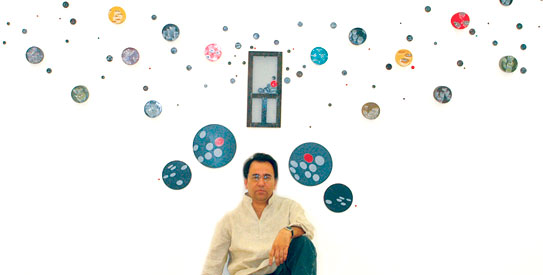
A product of Karachi School of Art, Saqib Moghal gained public attention during his first solo in 1999. He was signed by for a local daily as an artist while he was completing his art education but a career move in 1999 to the US took him to Miami, Florida where he now works as a creative director. After frequent showings of his work in Miami he returned for a solo at VM Art Gallery, Karachi, where he talked about the ‘then and now’ of his work.
Fleeting glimpses of tormented young women and symbolic references to wooden doors and windows in your paintings 10 years ago has now given way to complex conceptual compositions in a plethora of mixed media effects. Can you enumerate the reasons that have led to this conceptual and technical progression in your work?
I still make symbolic use of wooden doors and windows but fleeting glimpses of tormented young women have gone from my paintings. I was a fresh graduate when I painted such romanticised imagery—now in my late 30s away from country, family and friends I am experiencing life with a totally different viewpoint. In Pakistan I had no worries and as part of a large family was been taken care of by my elders. Since, moving to USA I have had to do everything myself and have learnt to value the worth of life.I feel the significance of my own country where I have friends, family, memories, beliefs and faith that make me a Pakistani. Maybe, I have led both lives as a careless young person and as a responsible man who experienced two cultures, standards, values, freedom etc.
Now I realise the difference between these small valuable things that we have as Pakistanis and chasing of fake standards related to ego, power and status in the West. By running after these things we delay our improvements and remain unstable. I have a lot to say regarding these sudden and quick changes that’s why you see so much going on in my paintings. Topics are jumping from one point to another but concerns and point of view are the same.
I always wanted to try new things that I could not get from my academic education. Mixed media gives me freedom to get effects as I want. I spend time and money to try new things that could go with my art skills. I draw a lot and also play with paints, mediums and surfaces to get visual effects—it’s fun.
Human figures with heads of ruined buildings symbolise a falling nation in your exhibition, ‘Break the silos’. Can you explain the meanings of other pertinent symbols that recur throughout your work?
The door symbol signifies ‘closed’ or ‘way to get out’. Open windows mean ‘awareness’ and ‘knowledge’ and closed windows, vice versa. The butterfly implies change—innocence—freedom. Textures of old walls symbolise home. As for gears with rotation belt around brain—eyes and lips: I make this picture where eyes (seeing), lips (talking) are controlled by the brain but the brain is also controlled by some other source which I have painted as a negative element, ‘devil/bad deeds/self-centredness’. And the eye images represent a questioning look. I paint broken matkas (vessels) as a symbol for ‘asset’.
Deriving artistic inspiration from conditions in Pakistan you paint of home away from home. What is it like to be an artist in diaspora?
Living abroad and viewing turmoil in Pakistan creates complex feelings, but distance does help one to put matters into perspective. Sometimes I think it is better to stay abroad and do whatever I can do for Pakistan from here. Another feeling is, am I a victim of brain drain?
Returning and exhibiting after a hiatus of 10 years have you noticed any changes in the art climate of Karachi?
The art climate has changed a lot. More galleries have opened, art prices have gone up and now, you see more serious work. People’s art viewing perception has improved but it is still restricted to upper class public and artists. New art schools are doing well while old ones are suffering.
I feel, this is the time when art galleries should work together to promote work outside Karachi. Some galleries have good links and can find sponsors to get booths in international art fairs. Artists from the middle class have no paths to get exposure to international markets while artists from the upper class have more chances because they have resources. Old art schools that represent the middle class can do a lot for their students but I am sorry to say that even after a decade this has not changed; rather it has deteriorated even more.




























