0
0

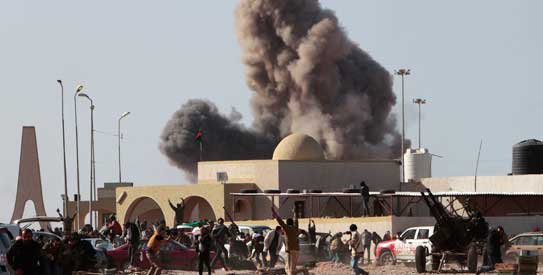
RAS LANOUF: Libyan warplanes launched at least three new airstrikes Tuesday near rebel positions in the oil port of Ras Lanouf, keeping up a counteroffensive to prevent the opposition from advancing toward leader Moammar Gadhafi's stronghold in the capital Tripoli.
There was no immediate word on casualties, and an Associated Press reporter who witnessed the strikes said they did not appear to hit any fighters.
On another front, a witness said Gadhafi loyalists have recaptured Zawiya, the city closest to Tripoli that had fallen into opposition hands. The witness, speaking to The Associated Press by phone, said Gadhafi's tanks and fighting vehicles were roaming the city 30 miles (50 kilometers) west of Tripoli and firing randomly at homes. He spoke on condition of anonymity because he feared reprisal.
Gadhafi's regime has been using its air power advantage more each day to check a rebel advance west toward Tripoli on the main highway leading out of the opposition-controlled eastern half of the country. The heavy use of air power underlines the vulnerability of the rebel forces as they attempt to march in open terrain along the Mediterranean coast and could prompt world powers to impose a no-fly zone over Libya to deny Gadhafi that edge.
The United States and its NATO allies edged closer Monday to formulating a military response to the escalating violence in Libya as the alliance boosted surveillance flights over the country and the Obama administration signaled it might be willing to help arm Gadhafi's opponents. Europe, meanwhile, kick-started international efforts to impose a no-fly zone.
It still appeared unlikely that U.S. warplanes or missiles soon would deploy in Libya, which has been sliding toward civil war, but the continuing violence increased pressure on Washington to do something or at least spell out its plan.
The rebels are fighting to oust Gadhafi from power after more than 41 years, a goal in common with the protesters who managed to topple authoritarian rulers in neighboring Tunisia and Egypt. However, the Libyan uprising has already proved much more violent, and could be much more drawn out.
In Benghazi, the main city in the rebel-held east of the country, a spokesman for the newly created Interim Governing Council said a man who claimed to represent Gadhafi has made contact with the council to discuss terms for Gadhafi to step down. Mustafa Gheriani told the AP the council could not be certain whether the man was acting on his own initiative or did in fact represent the Libyan leader.
''But our position is clear: No negotiations with the Gadhafi regime,'' said Gheriani, who declined to say when contact was made or reveal the identity of the purported envoy.
In Zawiya, the witness said electricity, phone and Internet services have all been cut. The witness spoke to the AP after he managed to escape the city through surrounding farmlands and reach a point outside Zawiya where mobile phone coverage was available.
''The city is in ruins,'' he said. ''Some buildings have been entirely destroyed and everyone on the street is shot on sight. There are many wounded but the hospitals are running out of supplies,'' he said, describing conditions in the city after the regime's counteroffensive on Monday.
As the fighting continues, Gadhafi's regime is also coming under mounting pressure from some Arab nations.
Gulf Arab countries joined the calls for a no-fly zone, with the foreign minister of the United Arab Emirates saying during a conference of his country's neighbors that the UN Security Council should ''shoulder its historical responsibility for protecting the Libyan people.''
Still, Western military intervention does not seem imminent _ and the warnings may be an attempt to intimidate Gadhafi with words before deeds.
British and French officials said the no-fly resolution was being drawn up as a contingency and it has not been decided whether to put it before the UN Security Council, where Russia holds veto power and has rejected such a move.
Western officials have said a no-fly zone does not require a UN mandate, but they would prefer to have one.