0
0

ISLAMABAD: Budgetary allocations for most of the projects in economic and social sectors designed to reduce poverty were not utilised during the last financial year.
“Alarmingly 11 sectors (out of 15) have recorded under-utilisation of budgetary allocations,” said an annual report of the Poverty Reduction Strategy Papers of the ministry of finance.
Maximum under-utilisation was observed in low-cost housing (61.5 per cent) and land reclamation (47.6 per cent) during 2009-10.
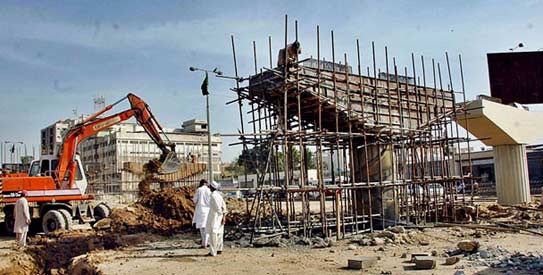
The report said that about 20 per cent of current expenditure for roads, highways and bridges was not utilised, while environment and water supply and sanitation sectors remained short of target by 13 per cent.
It said that the expenditure on population was lower by 18.42 per cent, while 9.35 per cent of funds were not utilised in health sector.
Substantial under-utilisation in excess of 10 per cent downward deviation was witnessed on the development side in all but four sectors -– environment, water supply and sanitation, social security and people’s works programme.
Natural calamities and disasters appeared with the minimum downward deviation of 7 per cent. Law and order and subsidies registered a negative deviation in excess of 50 per cent, indicating under-utilisation of approved development budgetary allocations.
On the current expenditure side, four sectors experienced over-utilisation of budgetary allocations, the maximum upward deviation was observed in subsidies at 53.6 per cent. Substantial downward deviation in excess of 10 per cent was observed in the remaining nine sectors.
The percentage of trained teachers has dropped by one per cent to 97 per cent at the primary level and 98 per cent at the middle level.
In Punjab and Khyber Pakhtunkhwa, 100 per cent teachers both at the primary and middle levels were trained, but in Sindh 92 per cent teachers at the primary level and 94 per cent at the middle level were trained.
At primary level, the percentage of trained teachers decreased by 2 percentage points in Sindh, 10 per cent in the AJK and five percentage points in Gilgit-Baltistan.
At the middle level, percentage of trained teachers decreased by one per cent in Sindh, 3 per cent in the AJK and one per cent in Gilgit-Baltistan.
A total of 42,736 private schools and 12,231 madressahs were reported across the country in 2008-09 compared to 58,350 private schools and 12,448 madressahs a year before, a 37 per cent decline in the number of private schools and a nominal fall in madressahs.
On the positive side, the record and recall-based full immunisation coverage of all eight recommended vaccines increased from 73 per cent to 78 per cent. The full immunisation rate went up by 9 per cent in Punjab to 85 per cent and 2 per cent in Sindh to 69 per cent, but it decreased by 1 per cent in Khyber Pakhtunkhwa to 71 per cent and by 14 per cent to 43 per cent in Balochistan.
The report said: “The forests occupy only 5.1 per cent of the total land area in Pakistan and are being depleted increasingly. Pakistan is facing one of the highest rates of deforestation in the world and has failed to meet its target of 6 per cent forests of total land area fixed for 2009-10.”
The government performance in providing clean drinking water remained dismal. During 2009-10, 370 water filtration plants were installed which made the cumulative number of 1,145, including those installed a year before.
Only 679 plants, including those installed in 2008-09, are functioning now. “Remaining 466 plants are not functional because of lack of the provision of electricity in rural areas and some other technical maintenance problems all over the country”.