0
0

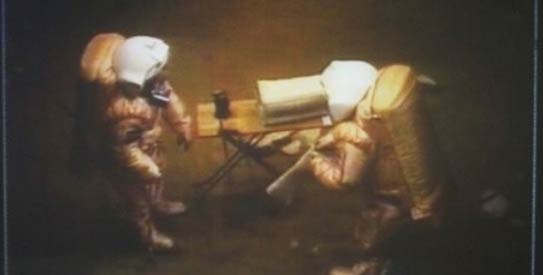
MOSCOW: The crew of a simulated international Mars mission ‘touched down’ on the red planet on Monday, marking the halfway point in an ambitious 1.5-year isolation experiment to test the strains of interplanetary travel.
Two of the six-man crew from Europe, China and Russia, who enlisted to be locked up in a mock spacecraft for 520 days, held their first sortie after eight months of cramped living in the 160-square-metre (1,720 square ft) module, parked in an institute on Moscow’s outskirts.
Dubbed Mars500, the ambitious experiment, the first full-duration simulation of a manned flight to Mars, aims to test one of the biggest unknowns of deep space travel: the mental and physical strains of such a journey.
The idea is to most closely mimic the timescale of a manned Mars flight -- 250 days for the actual flight, 30 days in orbit and surface landings and 240 days for the long return back to Earth -- all the way shuttling through imaginary space and cut off from the world below.
Russia’s mission control centre, which monitors real-life space flights, broadcast live footage of Russian Alexander Smoleyevsky and Italian-Colombian Diego Urbina trudging awkwardly under the weight of 32-kilogram space suits through a dark, sand-filled and rock-strewn room meant to imitate the surface of Mars.
Scientists with the European Space Agency (ESA) and Moscow’s institute of biomedical problems, who are running the ambitious experiment, admitted it cannot hope to test all the risks of a real manned flight to Mars, such as solar radiation and weightlessness.
But space officials reject comparisons the project has drawn to the television hit Big Brother.
“In the astronaut business we know that this is tough,” Christer Fuglesang, real-life astronaut and head of the life-science unit at the ESA, told Reuters.
“There is a real risk. You can stand being with someone you don’t like for a couple of months but for such a long mission the crew have to be very social people.”
He warned that after the “high” of their mock landing on Mars, the long, return journey would be the toughest period of the whole experiment.
Scientific reality show
The Mars500 volunteers, aged between 28 and 38, include a member of a real-life space programme and a civil engineer. But controversially no women were chosen for the study.
Only in the toilet are the crew free from cameras and observation. Videos posted on the Mars500 project’s blog show the men eating a mushy frozen diet, plastered with electrodes during workouts and naps, playing Nintendo wii and singing karaoke to break the monotony.
Like a real Mars mission, the all-male, six-man crew live on food rations like those of real-life space station astronauts. Showers come every ten days and contact with the outside is artificially delayed and disrupted to force the crew to fend for themselves.
In an emergency drill, scientists cut off electricity to the module for over 24 hours to see how the crew would handle a crisis.
“I am really convinced that the unique experience, which the Mars500 group continues to return to us... will be a strong asset for the future undertakings of man in its ambition to fly to the red planet,” said Martin Zell, who heads up the ESA scientific programme on the International Space Station (ISS).
The ESA, Russia’s Roskosmos and the US space agency NASA have separately sketched dates for a real manned flight to Mars in around 30 years from now.