



 0
0

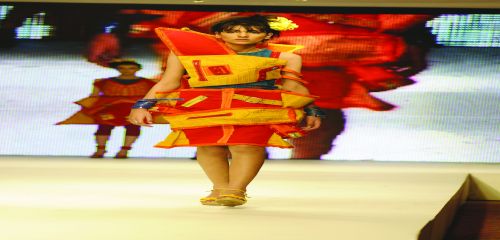
But above all it was an exercise in generating business interest for Pakistan’s fabric and its finished products, as well as opening windows of opportunity for international buyers and helping their local counterparts to gain access to international business markets, as well as the upcoming World Fashion Week 2011 in New York under the aegis of the World Fashion Organization. But more on that later.
DAY 1 (pret & luxury prêt day shows) Choreography by Amina Pomme Gohar Hair & make-up by Shaheen Saeed
Deeba and Zoe, a design team from Glasgow, Scotland, opened the show with an essentially black and shades of black collection after the Indian designers, Pradeep Kumar Agarwal in this case, could not participate due to visa issues. Shahzad Nawaz and Sumaira (SNS) put 11 outfits on the ramp which were mostly about frills and sheer volume, which in these times of economic recession failed to impress with their design philosophy. Envogue’s Hamida showed dresses with print paneling, and with it her design sensibilities were strewn all over the place with focus on wearability rather than creativity.
Rosettes (didn’t they become passé last year or before that), spaghetti straps, handkerchief dresses and unnecessary show of skin made the segment seem like a fashion school graduate show, and the dresses just kept on coming. It was lesson in what not to do and where not to go.
How can our designers create a market for their products when their design philosophy is so convoluted that they don’t have an idea of their target market? They need to focus more on the Pakistani because eventually that’s what will sell with foreign buyers.
A word to designers: don’t follow trends, create them otherwise adjectives such as ‘painfully basic’ and ‘predictable’ will be used to describe them, and when you do design flamboyantly to unleash creative potential.
On the contrary, when Shafaq Habib’s designer jewellery wear show commenced, one could see the notable increase in the crowd, most of them being her clientele. During her 28 years in design she has redefined the art of kundan jewellery and that evening the wow factor was in her improvised Egyptian royalty headdresses, neck and waist wear offset by turquoise stones and worn over neutral togas, showing a maturity of design. The result was that where some of the new models had earlier faltered, they showed poise, grace and confidence in her segment which goes on to show that a woman feels confident when she knows she’s wearing something classy and looking good.
Her other lines comprised more traditional eastern and pearl jewellery, and an improvised fusion line with gold discs and spiral designs. Shafaq cut to the chase from the word go. She had designs and she showed them with the 15 models -- five in each category.
DAY 1 couture show Hair and make-up by Tariq Amin
Ammar Belal showed his impressive menswear and women’s wear to the strains of popular ‘60s music with improvised choreography by Amina Pomme Gohar wherein the male models made a reverse entry on the ramp. Dressed in checkered and striped pants with jackets with the patent AB look, the smartly-dressed boys were complimented by the female models wearing smart oufits accessorised by sashes, bouble-breasted sleeveless jackets with box pleats, two-tone pleated loose pants and Ammar’s take on the Guggenheim Museum. The standard AB outfit is known to give personality when there is lack of one.
DAY 2 (prêt & luxury prêt-day shows) Choreography by Amina Pomme Gohar Hair & Make-up by Toni & Guy
The least impressive of all the days, the students of the Gujranwala Institute of Fashion Technology came to the rescue with their interesting take on fashion and technology by fusing them, with the result that the structured dresses had embellishing elements of springs, boxes and cogs as well as a fluorescent-green patent leather warrior outfit, an umbrella dress, a brown monk dress that fired the imagination. Also interesting was a short red jacket but some of the accessories were strongly reminiscent of Deepak Perwani’s bag collection he showed at Milan Fashion Week.
Lawrencepur showed the conservative men’s suiting in shades of gray, beige, light blue and off-white offset by loud yellow with accent on sharp cuts and body contour.
Bisma Ahmed failed to impress with her collection later on.
DAY 2 couture show Hair & make-up by Tariq Amin Rehana Saigol’s Jashn collection hovered above everything else shown that day with lehengas, chooridar pajamas and kurtas seeped in bling and intricate cuts, as well as the lehenga sari she had shown earlier on. The men’s collection by Shakeel Saigol was in a class of its own with interesting fabric employed for sherwanis and kurta shalwars, worn over Jodhpur pajamas.
Rehana’s design philosophy “Style over fashion, and to look like everyone else is death” shone through in this colourful segment. The showstopper was Nadya Hussain in a sensational classic bridal number which displayed the designer’s sense of superior style.
DAY 3 (prêt & luxury prêt-day shows) Choreography by Imran Kureishi Hair & make-up by Angie Marshall
Karachi-based Shaiyanne Malik showed a pristine white line offset by floral, Indian motifs worn with short coaties and complimenting hair accessories. She experimented with a wide palette later on in her formal and fusion wear and deeper shades.
What stood out were the silver-sequined embroidered panels in Rajasthani colours and patterns (or was it truck art?) worn with stunning parrot-green cholis.
Exaggerated cuts, vibrant cuts, a retro design philosophy and effective transition of thought into garment construction by the students of Iqra University’s fashion design department was the saving grace of Day Three of IFW. Their design sensibility belied their young age and it got them resounding applause towards the end of the show for an eye-catching candy-coloured collection. They have promise and it shone through loud and clear.
Chinyere also showed a vibrant selection of outfits from its Spring/Summer 2011 collection.
DAY 3 couture show Hair & make-up by Tariq Amin
The theme of Basant seemed to be on Kamiar Rokni’s mind when her assembled the collection that he put forth on the ramp in the couture segment later that day, for both men and women. It bore his signature and there was nothing new about it in terms of setting trends.
DAY 4 (prêt & luxury prêt-day shows) Choreography by Imran Kureishi Hair & make-up by Rukaiya Adamjee
It was Malaysian designer Sharifah Kirana Syed Ghazali’s second time in Pakistan to participate in a fashion week, her earlier stint being with Karachi Fashion Week. This time round she focused on hand-woven traditional fabric in vibrant colours with intertwined gold and silver thread and sparse embellishments. She observed that Pakistan and Malaysia have a lot in common when it comes to their respective cultures, with the fabric transcending borders as well. The cuts for the long skits with slits were conservative with sleeveless and long-sleeved blouses. She accessorised the outfits with traditional turbans and on the whole the collection received a highly encouraging response. No wonder she keeps coming back for more.
Huma Amir Adnan of FNK Asia put together a line with tiers on the fitted pants/pajamas and long, pleated shirts which is sure to send the friendly neighbourhood darzis in sewing frenzy. Overall, the collection that borrowed freely from Kashmiri and Pukhtoon cultures among others, and comprised improvised peasant skits and drop-crotch pants, looked fetching, radiant and worthy of initiating a new fashion trend. According to Huma, it’s already a sellout in India and the Gulf region. What more can one say?
Sanam Agha’s interesting takes on locally-produced cheap fabrics and Beenish Agha’s designs elicited a mixed response.
DAY 4 couture show Hair & make-up by Tariq Amin
The most-awaited show of the four-day IFW started off with a slide show of Nilofer Shahid’s impressive body of work through the years both locally and internationally. The signature creations were the epitome of elegance and class with an element of soul infused in them. Fouzia looked resplendent in a bold red front-slit long, figure-hugging skirt with a short bodice and a tassled long scarf.
Some of the beautifully structured garments were strongly reminiscent of classic, Victorian-era structures seeped in beauty and tradition. Nilofer believes a garment can be moulded to form any silhouette and it shows in her impressive body of work with no cut too difficult or impossible for her. Offset by intricate embroidery and appliqué, a NS outfit is a thing of beauty and a joy forever. What were shown that night were classics that have transcended the boundaries of time and style. She also showed an impressive menswear collection.
All the footwear was by Metro Shoes.
On the final day of IFW, a signing ceremony to welcome Pakistan as the National Chapter of the World Fashion Organization took place with Triple-E Events. It would facilitate buyers worldwide to enter Pakistani markets and vice versa, as well as introduce local talent at the World Fashion Week 2011 platform in New York.
PIA MD Captain Ejaz Haroon took the opportunity to announce a competition for all the IFW designers where they will be asked to design the new airhostess’ uniform which would be put forth for selection at a fashion show before the winner is selected.
Taking his cue, Arshad Siddiqui announced the formation of the Pakistan Fashion Council with Tariq Amin as its Chief Operating Officer. The announcement was welcomed by all those present and so concluded the four-day fashion fiesta that surpassed most fashion weeks on many counts.


























