0
0

KARACHI: It is difficult to document the mystical aspects of a religion or faith. What Sufism symbolises or stands for cannot be understood unless you see its true adherents immersed in it. Pirouetting men, pensive women and zealous youngsters at the shrine of Lal Shahbaz Qalandar in Sehwan look like a conventional sight, but each has a certain affinity with the saint, which to a great extent is indescribable.
German filmmaker Martin Weinhart's documentary The Red Sufi (based on writer and anthropologist Jurgen Wasim Frembgen's ethnographic narrative of his pilgrimage from Lahore to Sehwan) screened at the Goethe-Institut on Wednesday, tried to capture the zealousness with which the saint's followers celebrate his urs and the mystique that surrounds it. It was received with a mixed response.
The film begins in Lahore, where Frembgen is preparing himself for the pilgrimage, putting on shalwar-qameez, visiting people who are readying themselves to leave for Sehwan to partake in the celebrations. The preparations in Lahore are festive enough where flagellation knives and chains are being prepared, and men and women dance to the beat of the dhol and devotional songs.
During Frembgen's meetings with some young men he's told that there was a time when these things were done without restraint, but now the element of fear has crept in as Sufi shrines are being targeted by extremist elements. Then he embarks on a train journey to reach Lal Shahbaz Qalandar's shrine with other adherents of the saint.
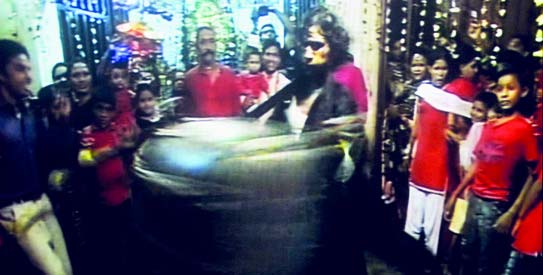
The scenes in Sehwan are bustling with energy, as shots of men and young girls losing themselves in trance dance are shown. Rituals related to the mazaar follow. Frembgen interacts and strikes up conversations with many people gathered at the shrine, including a bunch of eunuchs, trance dancer Muhabbat Saen, a regular visitor to the urs, Arif Saen, and his companion Bhola.
Bhola tells him that he has worked in film Bakhtawar in which he featured as a dhamal dancer. Then he sings a film song using a steel plate for percussion. This is followed by elaborate shots of langar (free food) as food in big degs (cauldrons) and bread loaves in a large quantity are cooked and baked.
The celebrations reach their culmination point as music is played and devotees of the saint, including a chain-carrying one, dance with complete abandon. The film ends with the red saint's saying: “I know nothing except love, intoxication and ecstasy.”
The Red Sufi was a decent effort, but lacked spontaneity, which is an important constituent of filmmaking. This was felt because it seemed as if the characters, particularly those who appeared to have idiosyncrasies, behaved in a particular way because the camera was facing them. Their consciousness of the camera took the spontaneity factor out of the equation. Also, only the sounds generated by the environment (traffic, music played by devotees, conversations) were used as background score; it kind of created an auditory monotony.
The screening was preceded by a little introduction to the film by Jurgen Wasim Frembgen who informed the audience that he's an old-comer to Pakistan and had been interested in the locally embedded forms of religiosity and was fascinated with the living expressions of Sufi traditions. He said Sufi religiosity was ignored by text-based scholars. It was in 2003 that he went on a pilgrimage to the Qalandar's shrine for the first time and found the experience emotionally intense. In 2008 he published the travel account of his pilgrimage, which Martin Weinhart (who had already made a film on Rumi) read and approached him to make a film based on it. And in 2009 they embarked on the project.
The film generated quite a debate in the hall, and questions were hurled at Mr Frembgen about focusing only on the ritualistic element of Sufism. He responded that it had a broad horizon and the filmmakers had touched just one aspect of it.