0
0

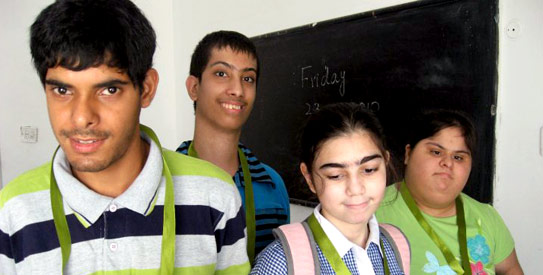
KARACHI: Saima Haq aka 'Sam' is the owner and brains behind the Special Children’s Education Institute (SCEI) that also includes a vocation centre. The institute also retails select products under the brand name of ‘Sunflowers’ in Karachi.
Though Haq was brought up in the US, she regularly travelled to Pakistan with her parents and eventually moved here after getting married. “I have always wanted to give something back to society in Pakistan. And eventually after settling in Pakistan I decided to go full-time into special needs.”
With a degree in Physical Education and Social Welfare from Berkley, California, Haq started teaching individuals with special needs from home. “My first student was a young girl with Down Syndrome and from there my initiative grew through word of mouth.”
After working with two students, Haq decided to train a teacher. “It is my policy that the ratio of student to teacher should always be two to one. As the number of students began to increase steadily so did the staff, and my home soon became a full-fledged school.”
The institute established in 1996, is located in Defence, Karachi and is inclusive of five classrooms, an audio/visual room, a speech therapy room, a vocational centre and a large ground for sports and outdoor activities. The school currently accommodates 35 students with special needs and 18 full-time staff members. The age of students range from three to 26 years. The institute also accepts donations and zakaat annually to support those families who cannot afford to pay.
Students who are brought to the school for admission purposes are put through a thorough consultation process as the aim is to only take on children who can be genuinely helped on a long-term basis from the programme.
Haq asserts, “We check to see the child’s ability to retain, recall and recognise information, their social skills and whether they will truly benefit from our programme.”
For most families in our society, a special needs school is seen as a last resort. Accepting the child’s learning difficulties is very important and usually is very hard to come by. Sometimes, even if one parent acknowledges the problem, the other will not. Haq elaborates, “It is usually a catch-22, with the mother knowing very well what is wrong with the child, yet with all the family support in our society there is also a lot of disparity between acceptance and treatment of the child's problem.”
Physical development, eye contact and especially speech, which is a direct link to the brain, at 18 months is not as easy to detect in special needs as compared to a normal child. Once it is detectable, one can gauge to some extent how developed the brain is of the child in correlation to its age.
According to Haq, “the lower-middle class work harder, they don't have time to go to 20 doctors and pay for numerous medical consultations, they simply accept and begin to work on the child accordingly.”
While people from the upper middle class and beyond prefer to research on their own with facilities such as the internet giving much false hope through those one-in-million stories that preach a full recovery and independence of a special needs child. Besides numerous consultations locally, some families also take the child overseas for second opinions from specialists who either give the exact same diagnosis or false hope. Usually, it is the parents who need to be dealt with more tactfully.
“One has to simply keep striving. We are continuously dealing with parents’ denial at each stage of the child’s development. As the child grows into new phases from adolescence to adulthood, it can be exhausting for the parents to feel that they are starting from square one with their child,” explains Haq.
As the child grows into adults their emotions can become more heightened some may want to be out of the house all the time whilst others simply want to watch TV throughout the day.
Haq highlights that, “children with a normal appearance face a harder acceptance of their problem as compared to those whose appearance correlates with their problem such as downs syndrome children and so on. This can make things quite challenging for family and others to accept and deal with the issue head on.”
Haq envisions the institute as an exemplary model for special needs education throughout Pakistan “My main aim is to create an environment conducive to the needs of the child and family where they are treated normally and become a model for the community to understand their challenges. And provide basic education to cater to their potential with as much support as possible.”
Teacher training and recruitment is unfortunately one of the toughest challenges of teaching special education in Pakistan. Although University of Karachi offers a master’s degree in special education, most graduates do not have real work experience and as important as theoretical knowledge is, it does not prepare one for the challenges of working with these children. Therefore SCEI takes the responsibility of training its own staff and has had a great deal of success in hiring teaching aides, even those without a strong academic background but have shown compassion for these children and are willing to work hard to be good educators.
The current curriculum covers ADL (activities of daily life), physical, speech and occupational therapy. Therapy programs are interwoven into each day, focussing on cognitive language, fine-motor, gross-motor, socio-emotional and self help. All students receive extensive therapy from certified therapists who work closely with teachers and parents to ensure the given therapies are working to the benefit of the individual child’s progress and daily functionality.
In the mission to give these special boys and girls a ‘normal’ childhood and learning experience, the school annually observes the usual Eid, Christmas, Haloween and Earth Day celebrations.
Haq passionately advocates the reality of such individuals, “I feel the term ‘mental retardation’ should not be shunned as it skews the actual problem from the public eye, the worst thing we can do is keep these children hidden. These children are special because they are different, they feel every part of their world as much as we do, and they have heightened visual awareness as we live in a visual society but they absorb information differently from how we do.”
She feels the earlier the child is put into a constructive routine the better the child’s future will be, “We aim to get children into the system as early in childhood as possible and provide a lifelong environment. With early intervention we aim to provide each child with cognitive, academic and physical education.”
The vocational centre is still relatively new and mostly gaining publicity through word of mouth and support through Facebook. In the vocational centre the children learn to decorate wooden trays, wall hangings, gift boxes, decorative envelopes, thematic bedroom storage bins, wedding trays with floral appliqués, block printed tissue paper as well as piñatas and birthday party theme decorations, which are all available for purchase or order. The wall hangings and wooden trays are available for sale at N‘eco’s in Defence.
Haq explains the ideology of this, “I feel from this process the child learns a skill that can support them through life and that buying a present from this initiative rather than the numerous gift shops selling the same products makes the gesture that much more valuable.”
The school aims to create awareness on a mass level especially to the lower economic sector, that help and support for such children is readily available and accessible. SCEI hopes to provide financial aid to at least 20 per cent of its student body.
Hiba J. Zubairi contributed for Dawn.com